
An Corran
Geological Conservation Review site | GCR #3271 | Palaeontology | Jurassic - Cretaceous Reptilia
Geological Conservation Review site | GCR #3271 | Palaeontology | Jurassic - Cretaceous Reptilia
Scotland's geosites are chosen because of their local, national or international importance. Take only photos, leave only footprints: avoid causing any damage to this site. You can walk almost anywhere in Scotland without the need to ask permission or keep to paths, but you have a responsibility to care for your own safety, to respect people's privacy and peace of mind and to cause no damage.
The right of access does not extend to quarries, building sites or any land where public access is prohibited, or to the collection of geological samples.
The sliver of exposure at the foreshore at An Corran on the south shore of Staffin Bay has over 15 large in-situ dinosaur footprints on the top surface of a bioturbated sandstone. It is bound by a Tertiary dyke to the west and is undercut by a Tertiary sill intrusion exposed on the seaward side to the east (Cox 2002, Clark et al. 2004). Within the thicker section of Tertiary sill above An Corran, is a raft of baked Kilmaluag Formation ostracod-rich sediments, suggesting that the sliver of Duntulm Formation on the foreshore is from close to the top of the Duntulm Formation. Dinosaur footprints are found at the top of two bioturbated calcareous sandstones. The lower of the two sandstones contained paired vertical burrows (?Arenicolites), and Rhizocorallium along with large theropod dinosaur footprints, and the upper sandstone contained large numbers of simple vertical tubes (Skolithos)as well as a smaller ornithopod dinosaur footprint that was found on a loose block (Clark et al. 2004). These footprints include the largest theropod footprints to be found in Scotland, the only dinosaur remains from the Duntulm Formation, and a significant addition to the dinosaurs represented in the Middle Jurassic of the Isle of Skye. These footprints are also the only exposed in situ dinosaur footprints in Scotland.
The sediments are poorly represented and are difficult to correlate with any other exposure of the Duntulm Formation in Trotternish, Isle of Skye. The GCR interest in this site is with the Middle Jurassic dinosaur trackways that are found in situ and in loose blocks on the foreshore. The presence of these Middle Jurassic dinosaur footprints ties in with work being carried out in NE England, and Oxfordshire, England, as well as elsewhere on the Isle of Skye. They are an important addition to our understanding of British, European and World Middle Jurassic dinosaur faunas. Similar footprints have been found in Upper Jurassic and Cretaceous rocks of North America, Asia and Europe and the Upper Triassic of North America, however accurate diagnosis of dinosaur footprints is problematic and a review of ichnotaxonomic methodology is required. It will be important that these footprints are included in such a study.
The in situ footprints have the advantage of not being part of a temporary working quarry exposure, but are seasonally covered by a thick protective layer of sand. They are usually exposed throughout the late Autumn to late Spring. The site is easily accessible and is often used by local enthusiasts and those involved in tourism and education. The accessibility makes the track site a tourist attraction as well as a research resource for visitors to the north of the Isle of Skye.
International Value: Dinosaur remains of the Middle Jurassic are rare worldwide. Large dinosaur footprints are known from the Middle Jurassic of England, Portugal and the United States. The footprints from the Duntulm Formation at An Corran provide evidence for large theropod dinosaurs with tracks of over 50cm in length making them amongst some of the largest theropod dinosaur footprints of this age. Tracks of similarly large theropods are now also known from temporary exposures in a landfill quarry in Oxfordshire and from the Cleveland basin of Yorkshire. Research links with Wyoming, USA, will allow comparative studies to be undertaken and it has been proposed that the An Corran site be part of a geological twinning exercise with dinosaur localities near Shell, Wyoming because of the similarity in age and footprint type.
The An Corran site is situated about 400m to the east of the Portree-Staffin road, A855, just before the hamlet of Stenscholl.
A small car park is situated by the slipway at An Corran where there is also an interpretive sign showing examples of footprints etc.
https://www.researchgate.net/publication/29816530_Dinosaur_…
Dinosaur footprints from the Duntulm Formation (Bathonian, Jurassic) of the Isle of Skye
N. D. L. Clark | P. Booth | C. Booth | D. A. Ross. Scottish Journal of Geology 40(1) April 2004
Footprinte site is situated of a level wavecut platform but seaweed can make to going slippery at times. If the sand or shingle levels are high, or seaweed is abundant, then, unfortunately, many prints will be very difficult to locate. A visit at low tide would also be advantageous.
There are no site highlights yet.
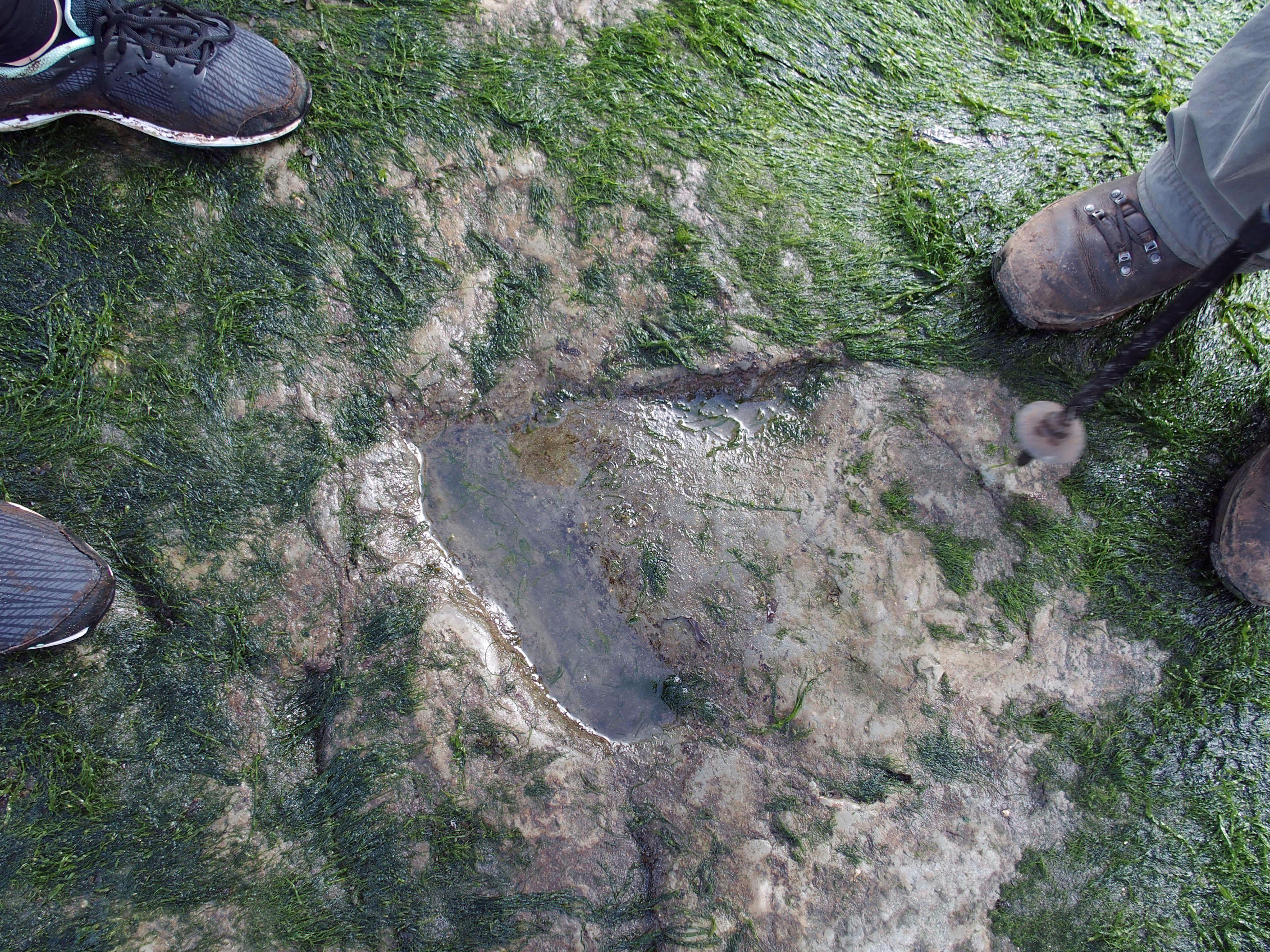
This example of a theropod print is badly eroded but the general outline can still be discerned.
Dave Longstaff
April 9, 2016
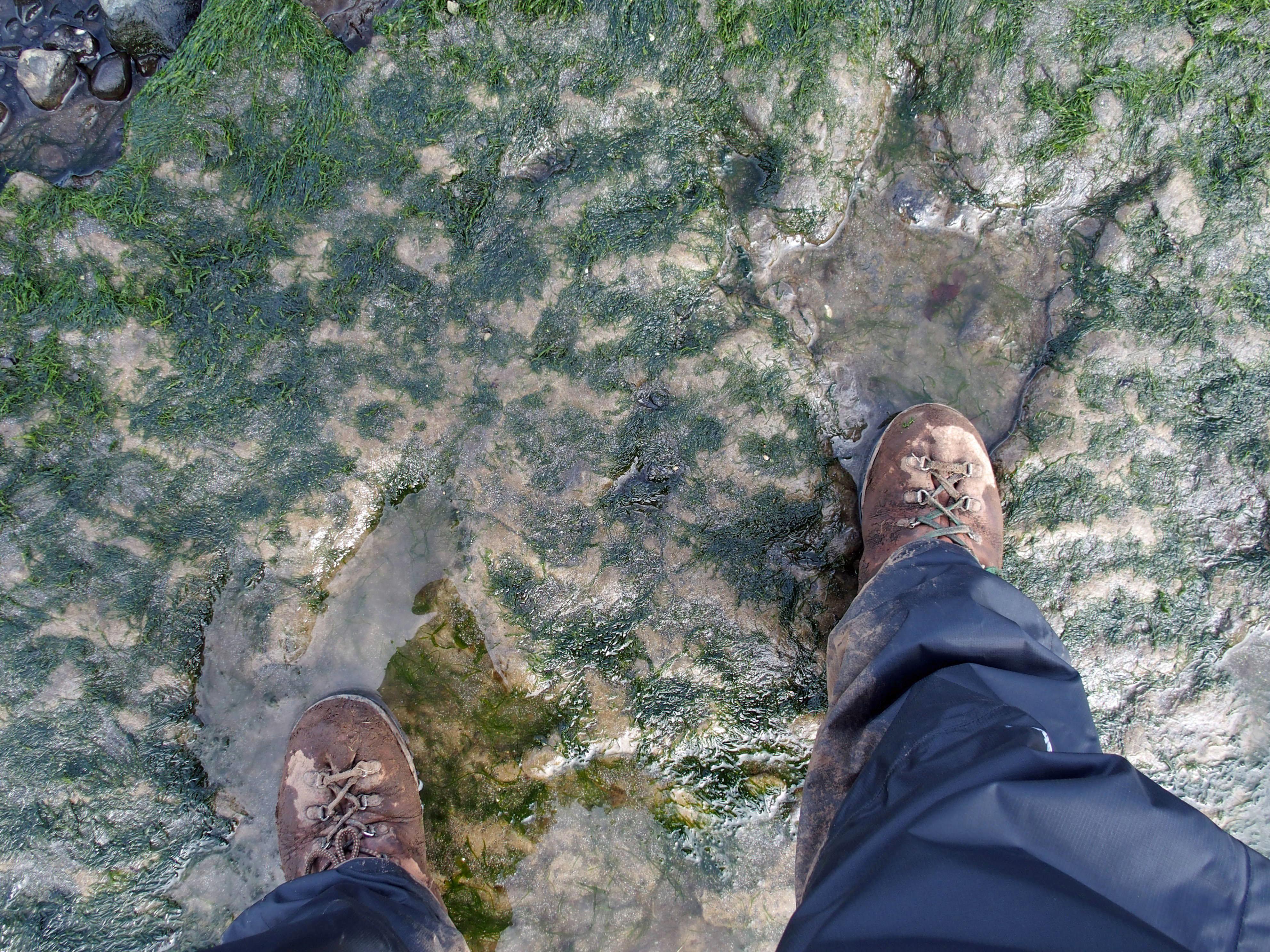
2 theropod footprints with 3 digits clearly visible on the example at right.
Dave Longstaff
April 9, 2016
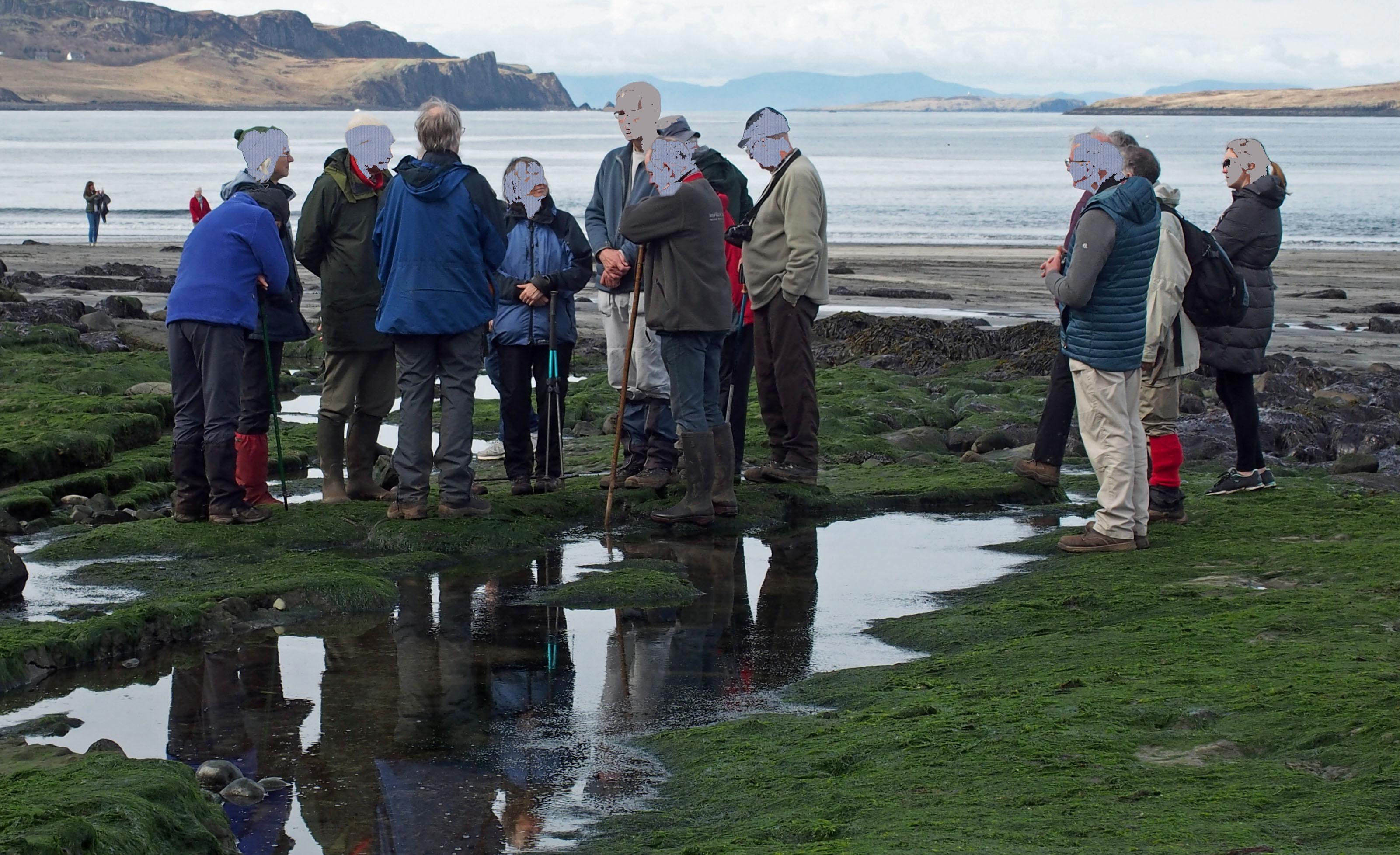
Group at footprint locality on the An Corran wavecut platform looking north towards the cliffs near Flodigarry.
More prints can be found in the area behind where the photographer was standing.
Dave Longstaff
Jan. 1, 2025
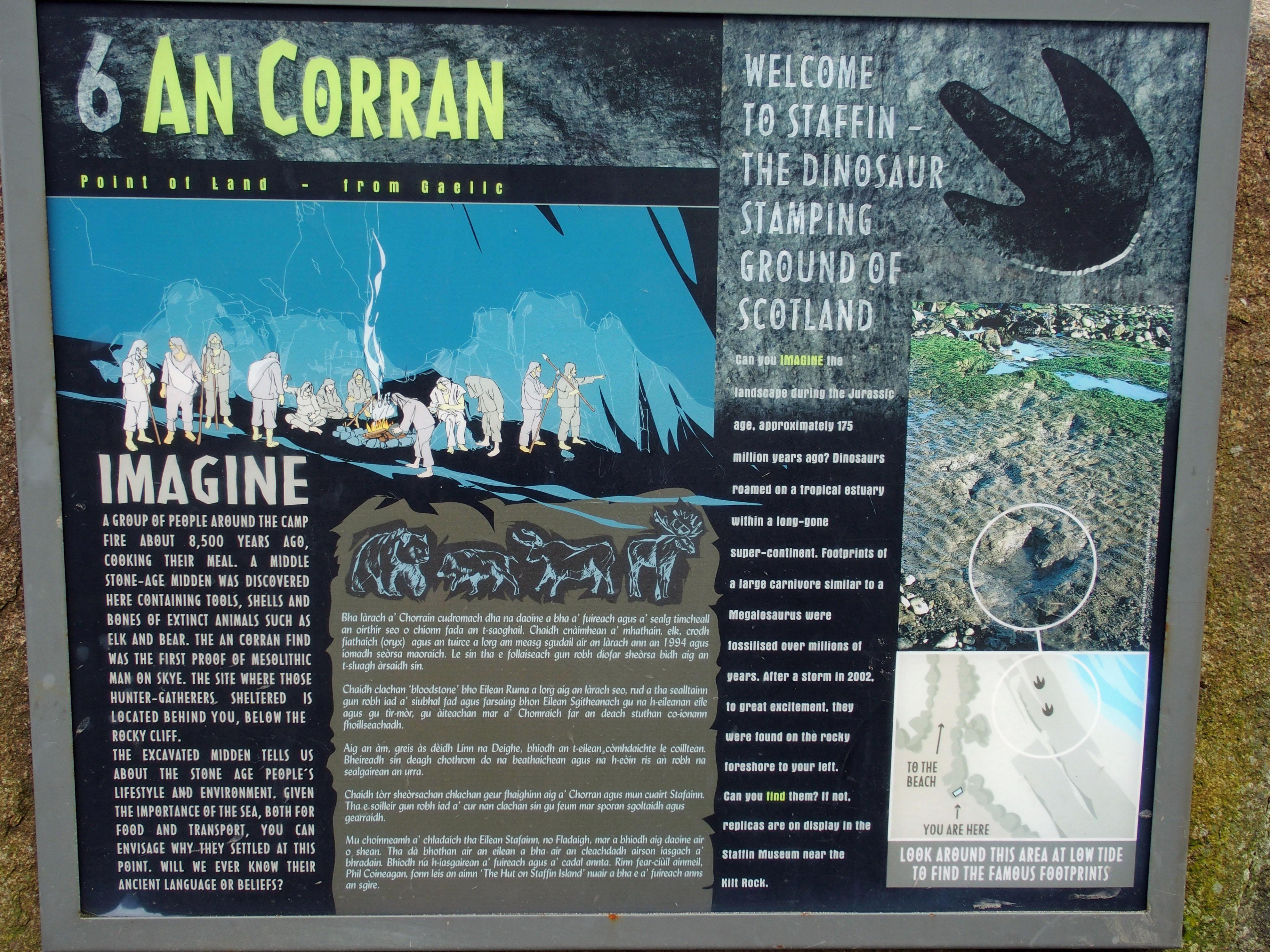
Information sign by by the car park at An Corran. Situated by the slipway which gives access to the wavecut platform.
Dave Longstaff
April 9, 2016