
Ben Vuirich
Geological Conservation Review site | GCR #3298 | Structural and Metamorphic Geology | Dalradian
Geological Conservation Review site | GCR #3298 | Structural and Metamorphic Geology | Dalradian
Scotland's geosites are chosen because of their local, national or international importance. Take only photos, leave only footprints: avoid causing any damage to this site. You can walk almost anywhere in Scotland without the need to ask permission or keep to paths, but you have a responsibility to care for your own safety, to respect people's privacy and peace of mind and to cause no damage.
The right of access does not extend to quarries, building sites or any land where public access is prohibited, or to the collection of geological samples.
The Ben Vuirich Granite is one of a small suite of granitic intrusions formed ~ 600 million years ago, before the main deformation and regional metamorphism of the Dalradian country rocks. Its field relationships reveal evidence for the relative timing of the main structural events that have affected the area.
The Ben Vuirich Granite pluton is a small NE-SW trending, sheet-like body intruding metasedimentary rocks belonging to the middle part of the Dalradian succession. It is a grey medium-grained granite, composed of quartz, plagioclase and potassium feldspar, with minor biotite and muscovite, and conspicuous red garnets. Foliation in the granite dips steeply SE. Its radiometric age of 590 Ma gives a minimum age for the Dalradian. At issue is the timing of granite intrusion relative to the first two phases of deformation of the Dalradian (D1 and D2). At NO991703 the contact metamorphic aureole of the granite is exposed: a spotted hornfels containing andalusite and cordierite with a weak tectonic fabric, suggesting intrusion post-dated D1.
On the lower slopes of Carn Dubh (NO011692), an irregular contact of the granite with quartzose psammite is well exposed, with veins of granite cutting the country rock. The intrusion contains many xenoliths of foliated psammite, ranging in size from tens of centimetres to several metres. Generally the foliation is parallel to the long axis of each xenolith, but in some it is at a high angle and a few show isoclinal folds, also suggesting intrusion was post-D1 but pre-D2. The GCR interpretation is that the folds result from D2 deformation of the foliation in suitably orientated xenoliths. It is also possible that the folds in the xenoliths are of synsedimentary origin.
Ben Vuirich is 5 km north of the A924 Pitlochry to Glenshee road. It can be reached by hill tracks from Tarvie (park at NO00756361) or Straloch (park at the old primary school) or Glenfernate (park at NO049639; a bike can be used on the private Glenfernate road). The Tarvie route is the shortest. From the track junction at NO 010662 follow the Tarvie burn to a wide peaty col, cross the Allt Daimheidh and continue north for another 1km to the outcrops at the foot of the slope of Carn Dubh.
7km/2 hr walk along hill tracks and open moorland, which can be boggy; well within the capabilities of the average hillwalker. Three gates and two footbridges in excellent condition.
There are no safety notes yet.
There are no site highlights yet.
There are no further information notes yet.
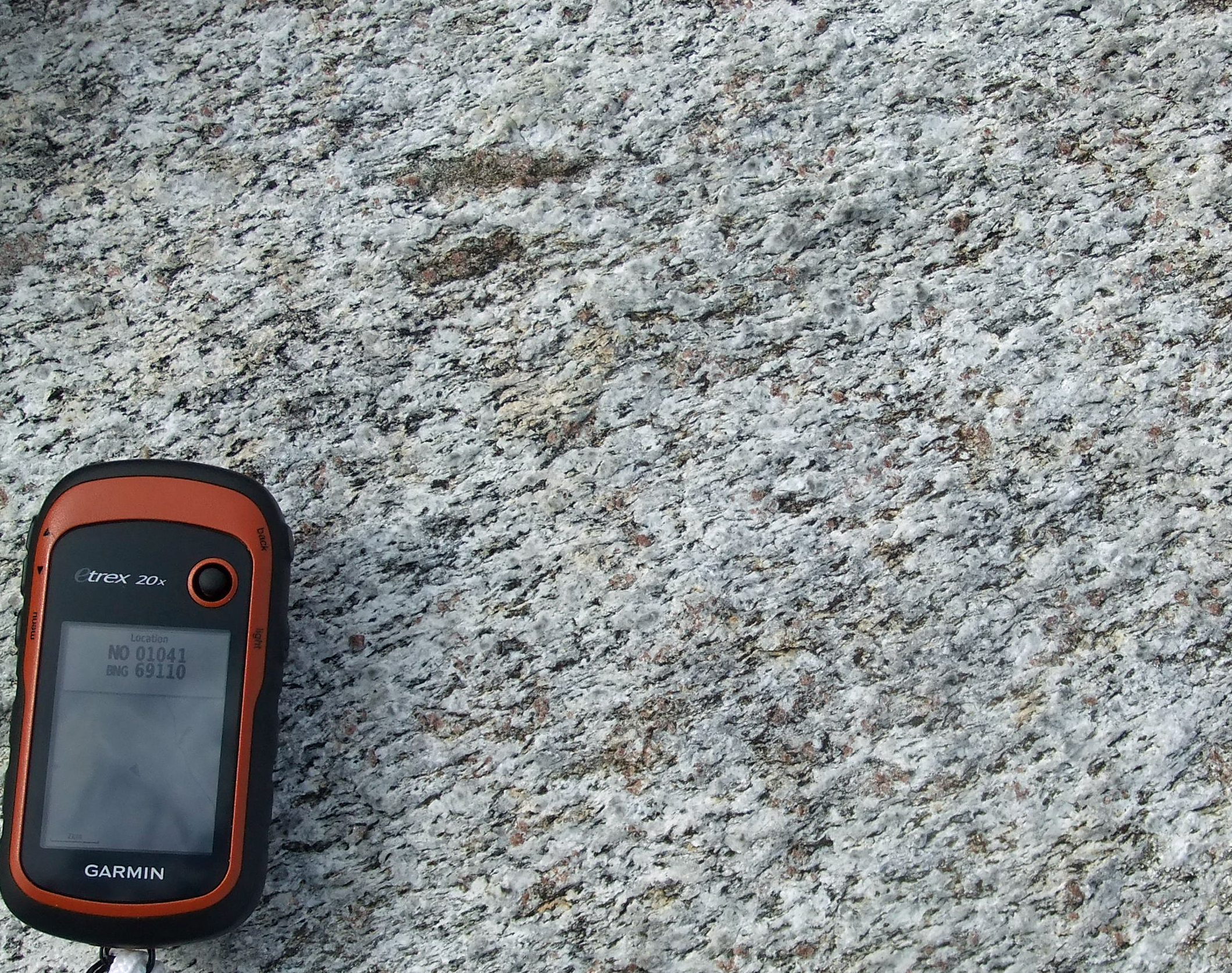
Typical foliated granite near the contact, with garnets (pink) and small xenoliths of schist (grey)
Carol Pudsey
Sept. 14, 2019
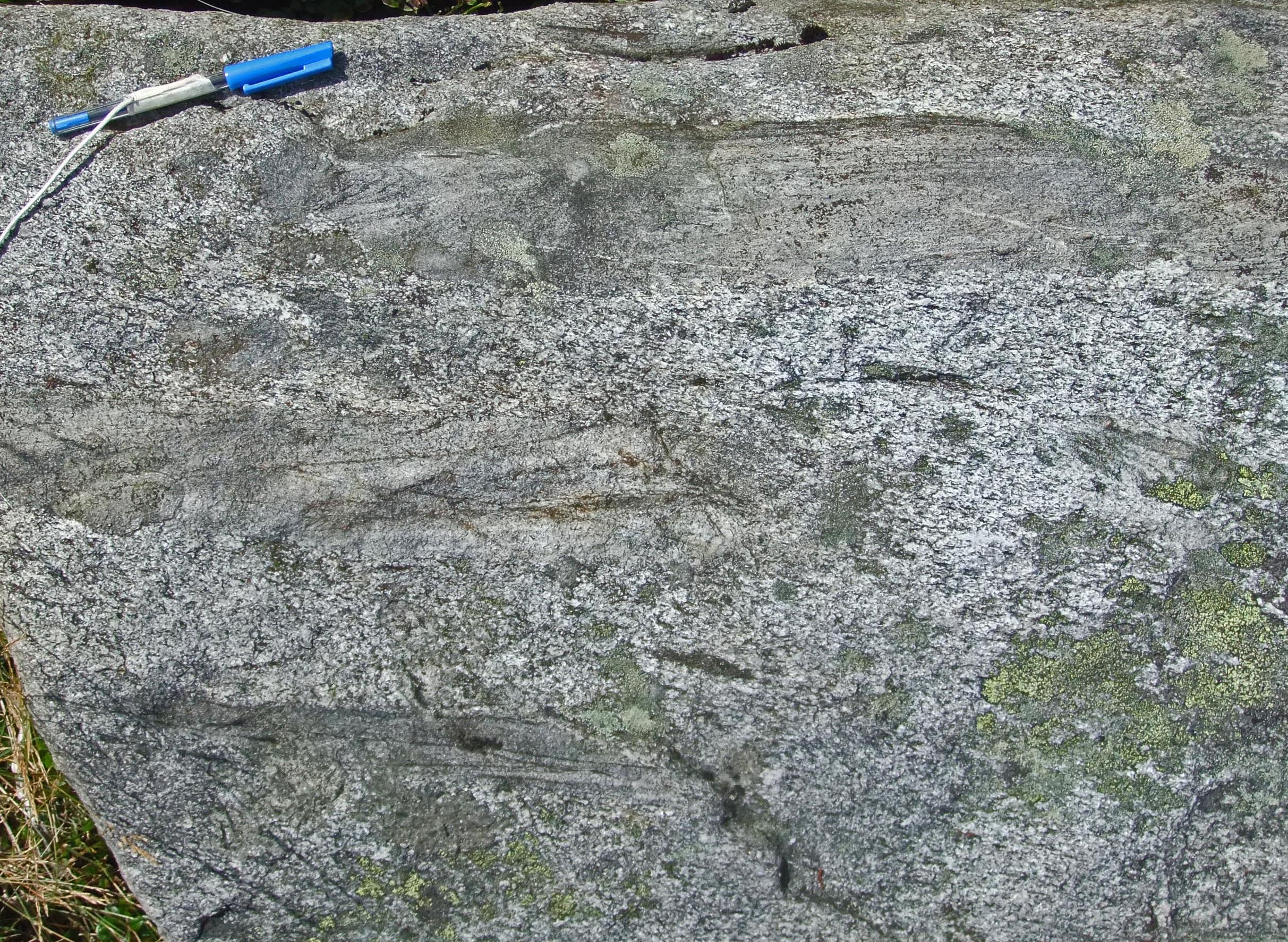
The uppermost xenolith contains an isoclinal fold (left-hand end)
Carol Pudsey
Sept. 14, 2019
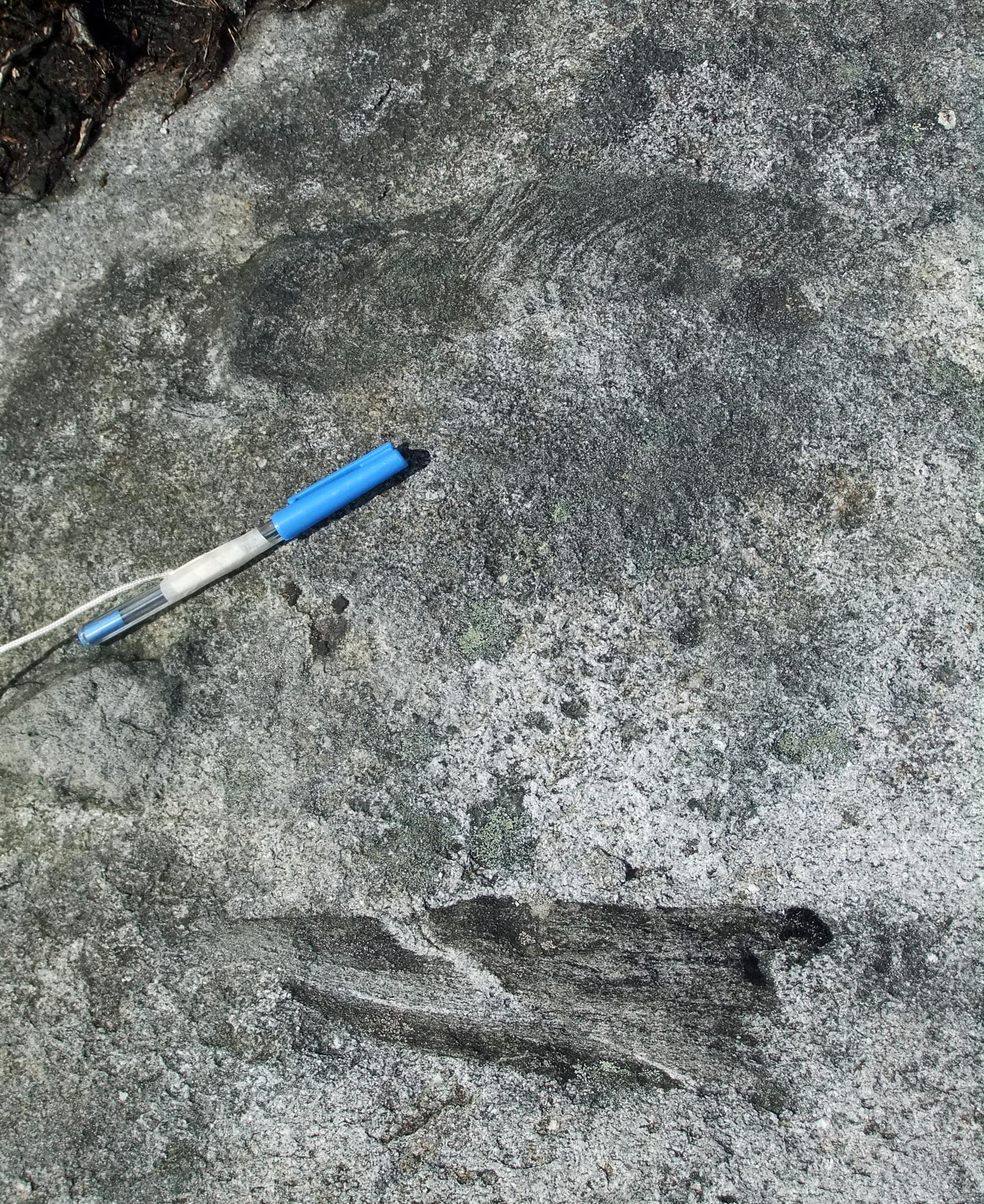
Xenoliths of schist in granite. The foliation in the lower xenolith is parallel to its long axis and to the granite foliation, but in the upper one the foliation is at a high angle to the long axis and is slightly folded.
Carol Pudsey
Sept. 14, 2019
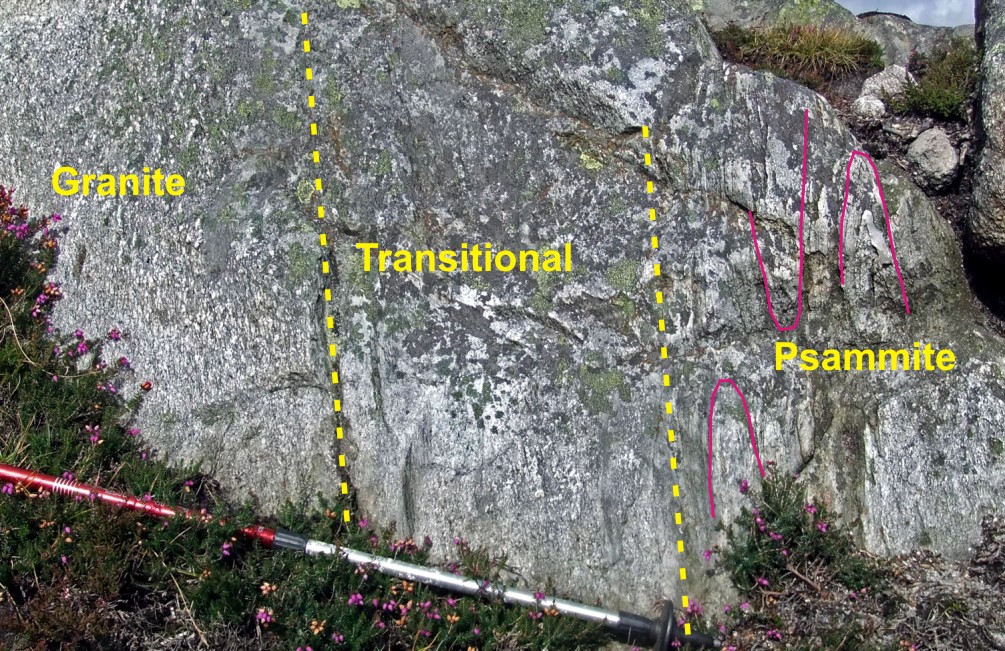
Contact between granite (left) and psammite (right). Isoclinal folds in the psammite are picked out in pink. There is a sheared transition zone about 35cm wide.
Carol Pudsey
Sept. 14, 2019
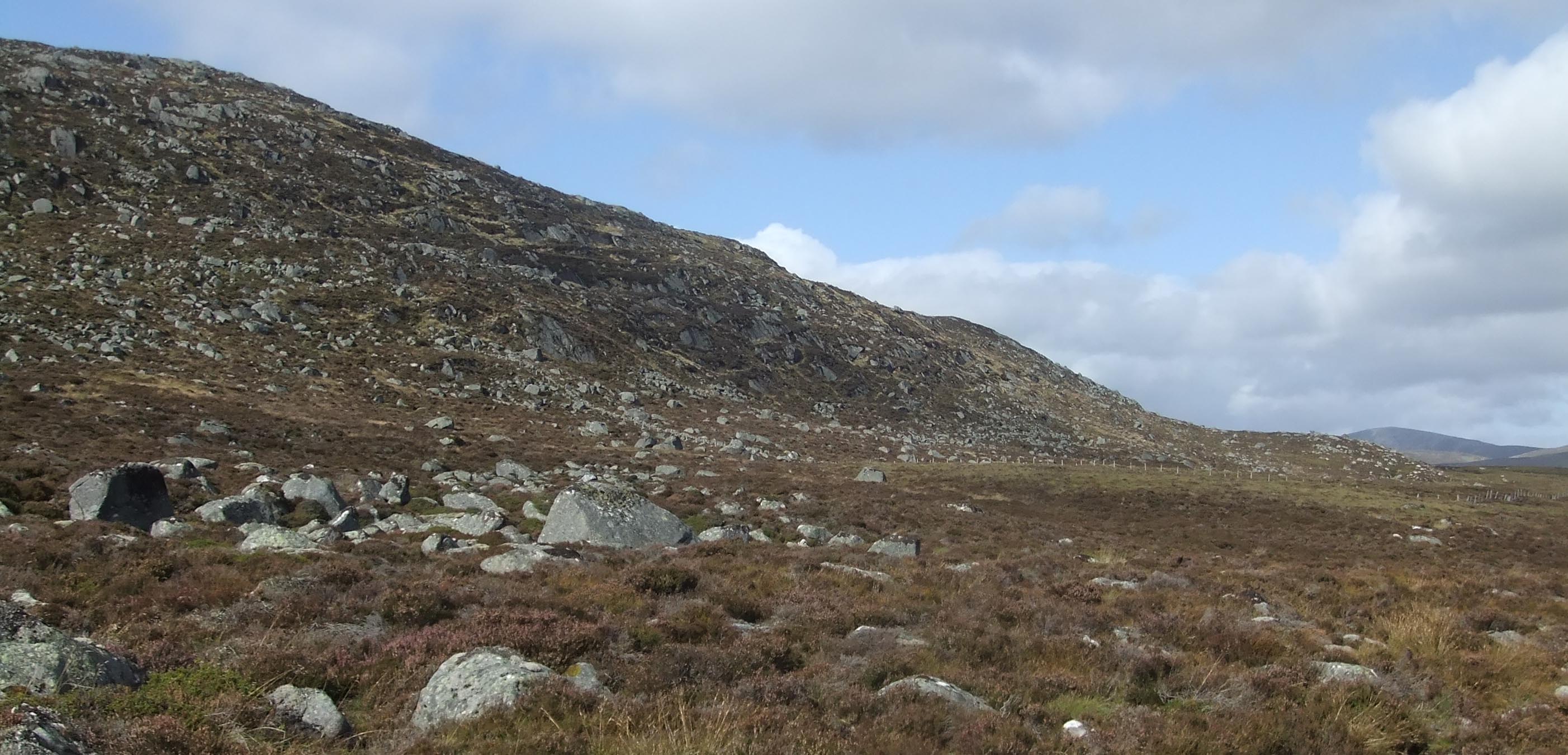
Carn Dubh from the south. The edge of the granite is at the foot of the slope, extreme right.
Carol Pudsey
Sept. 14, 2019