
Arthur's Seat Volcano
Geological Conservation Review site | GCR #188 | Igneous Petrology | Carboniferous - Permian Igneous
Geological Conservation Review site | GCR #188 | Igneous Petrology | Carboniferous - Permian Igneous
Scotland's geosites are chosen because of their local, national or international importance. Take only photos, leave only footprints: avoid causing any damage to this site. You can walk almost anywhere in Scotland without the need to ask permission or keep to paths, but you have a responsibility to care for your own safety, to respect people's privacy and peace of mind and to cause no damage.
This site is a Site of Special Scientific Interest (SSSI). It is an offence to intentionally or recklessly damage the protected natural features of a SSSI, and this includes unauthorised sample collection.
The right of access does not extend to quarries, building sites or any land where public access is prohibited, or to the collection of geological samples.
A small eroded basaltic volcano located close to Edinburgh city centre. Arthur's Seat includes surface lava flows, ash layers, vent material and sub-surface intrusions. Through the work of James Hutton the site has an important role in the historical understanding of the nature of igneous rocks.
The small composite volcano of Arthur's Seat erupted about 342 million years ago (Lower Carboniferous), is one of the most studied ancient volcanoes of the world. Research began over two hundred years ago and the area played a significant role in the early establishment of geological science, in particular for the evidence supplied at Salisbury Crags vital in demonstrating James Hutton's understanding of the formation of igneous rocks.
All the component parts of a typical strato-volcano are well-displayed and the sequence of the eruptions can be traced with a continuity unique in Britain. Features of special note include vents showing a wide variety of fillings including a lava lake and spectacular agglomerates, over twenty lava flows separated by ash layers (tuff), often water-laid, and a range of intrusions.
The site includes the separate Castle Rock plug and the later sill intrusion at Salisbury Crags, possibly the earliest of this type of intrusion to be recognised. Associated sedimentary rocks, in places fossiliferous, enable the palaeo-environments which existed during the volcanic activity to be determined in unusual detail.
In view of the excellence of the exposure and the wide range of features of interest, the Arthur's Seat Volcano is one of the most heavily used educational areas in Britain.
The different parts of the Arthur's Seat volcanic complex are easily accessible from central Edinburgh. Most people access Holyrood Park from Holyrood Palace at the foot of the Royal Mile. There is a car park at NT269737. The Queen's Drive, which gives access to the interior of Holyrood Park, has restricted opening hours - check with the Ranger Service.
https://www.edinburghgeolsoc.org/publications/geological-ex…
Discovering Edinburgh's Volcano - a geological guide to Holyrood Park. Published by the Edinburgh Geological Society and available to buy as a fold-out leaflet, or a free pdf download.
https://www.historicenvironment.scot/learn/ranger-service/
Holyrood Park Ranger Service (contact for access to Hutton's Section)
https://www.historicenvironment.scot/visit-a-place/places/h…
Holyrood Park - Historic Environment Scotland (information about access, road and path closures)
https://sitelink.nature.scot/site/91
Arthur's Seat Volcano SSSI
https://geoguide.scottishgeologytrust.org/p/egs/egs_lo/egs_…
Lothian Geology: an excursion guide
Hutton's Section, close to the Radical Road at the south end of Salisbury Crags was described by James Hutton and used as evidence to support his ideas about the nature of igneous rocks. He showed that the dolerite rock of the Crags was formed from magma that had been forcefully intruded into older sedimentary rocks. The Radical Road is currently closed, contact the Ranger Service for access.
Many of the paths are rough and rocky underfoot. There are cliffs and steep slopes.
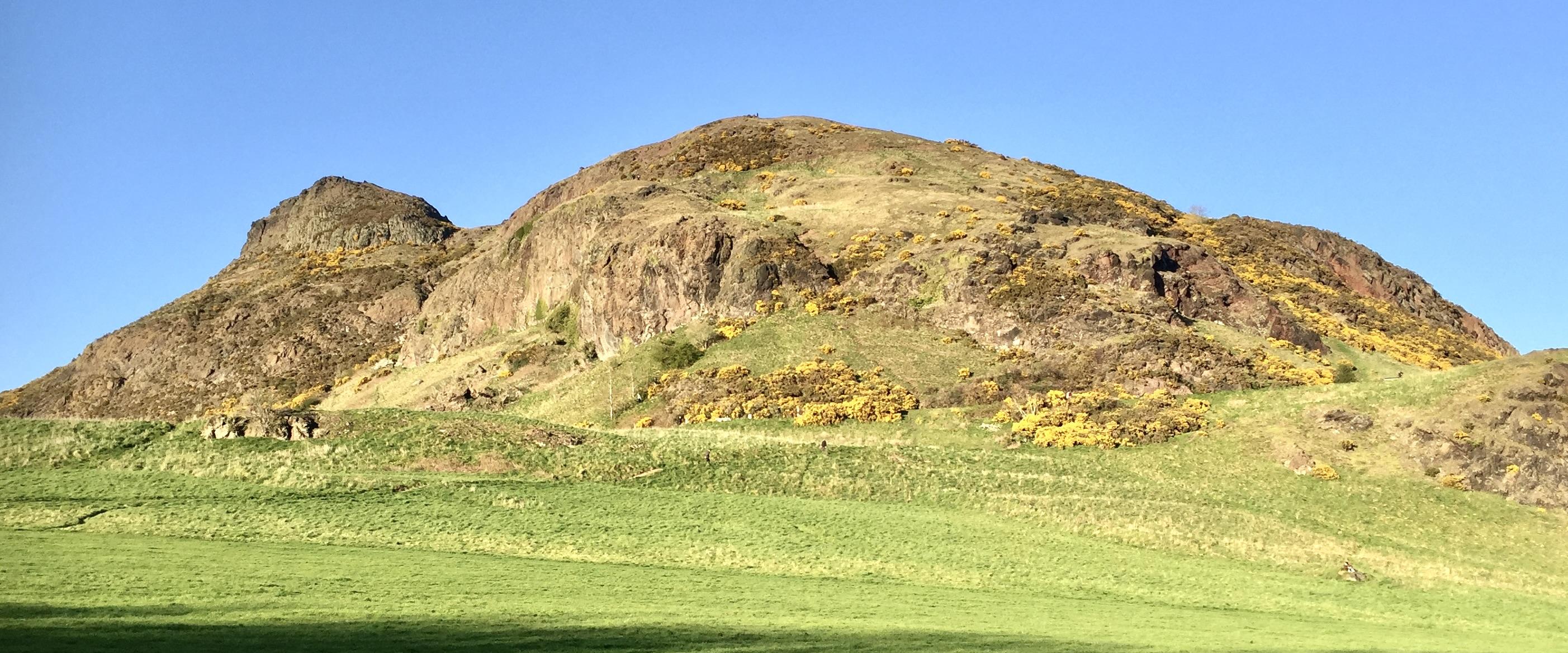
Arthur's Seat from the west, near entrance to Holyrood Park from Commonwealth Pool.
Con Gillen
April 19, 2023
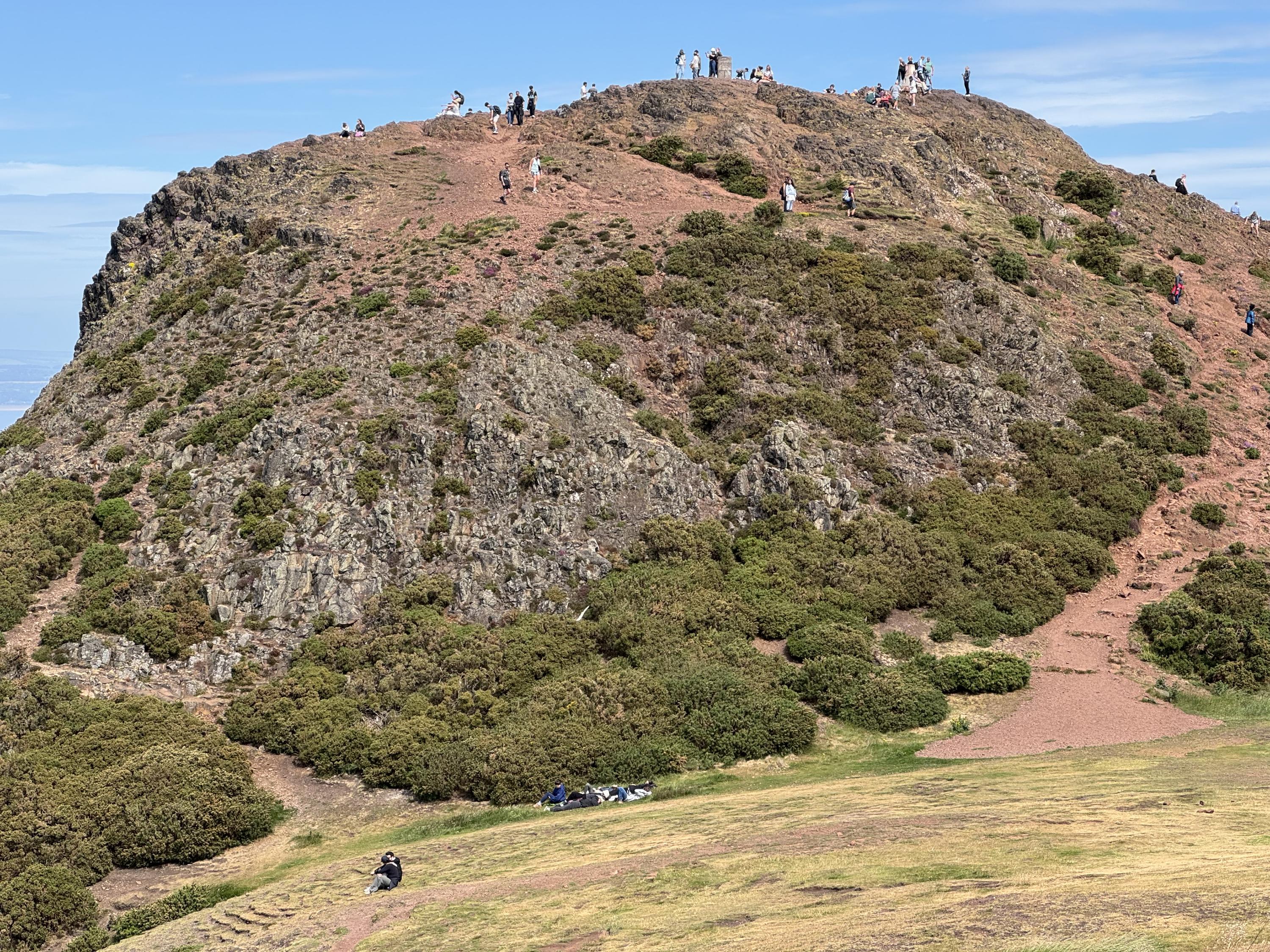
Summit area of Arthur's Seat; rough cooling joint pattern seen in cliffs.
Con Gillen
June 29, 2025
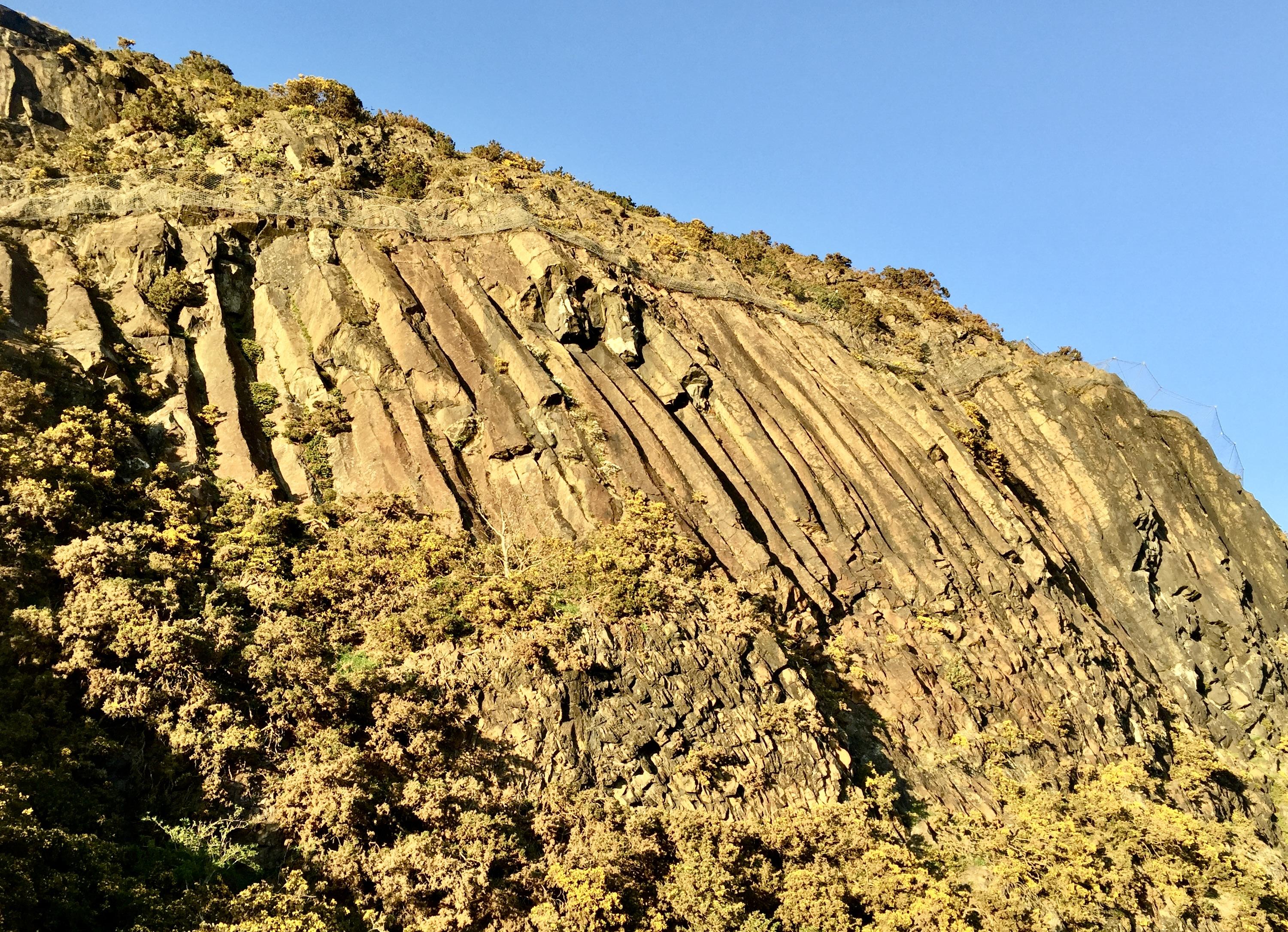
Samson's Ribs, showing columnar jointing.
Con Gillen
April 19, 2023
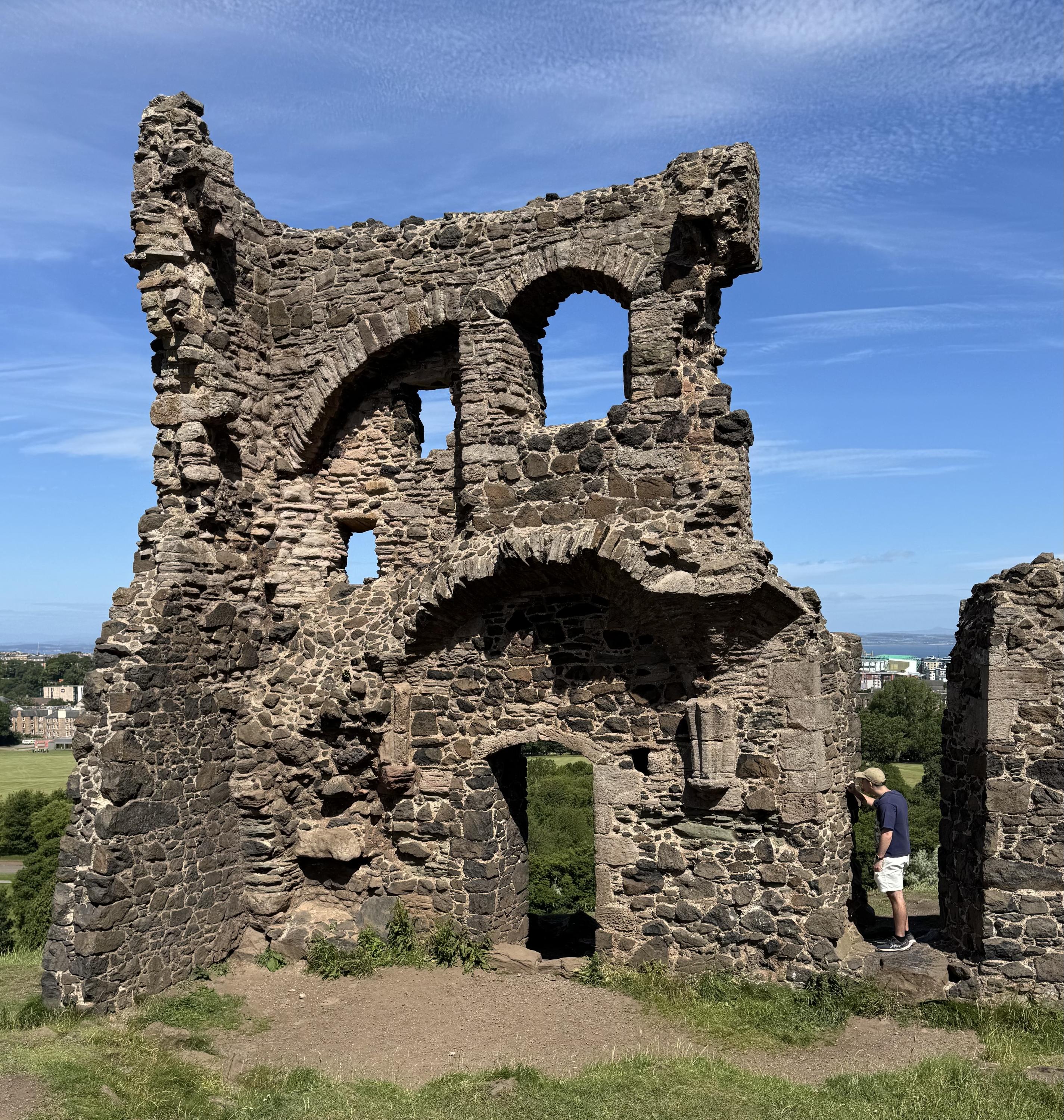
Ruins of St Anthony's Chapel, showing irregular angular basalt rubble walls and sandstone around carved windows and arches.
Con Gillen
June 29, 2025
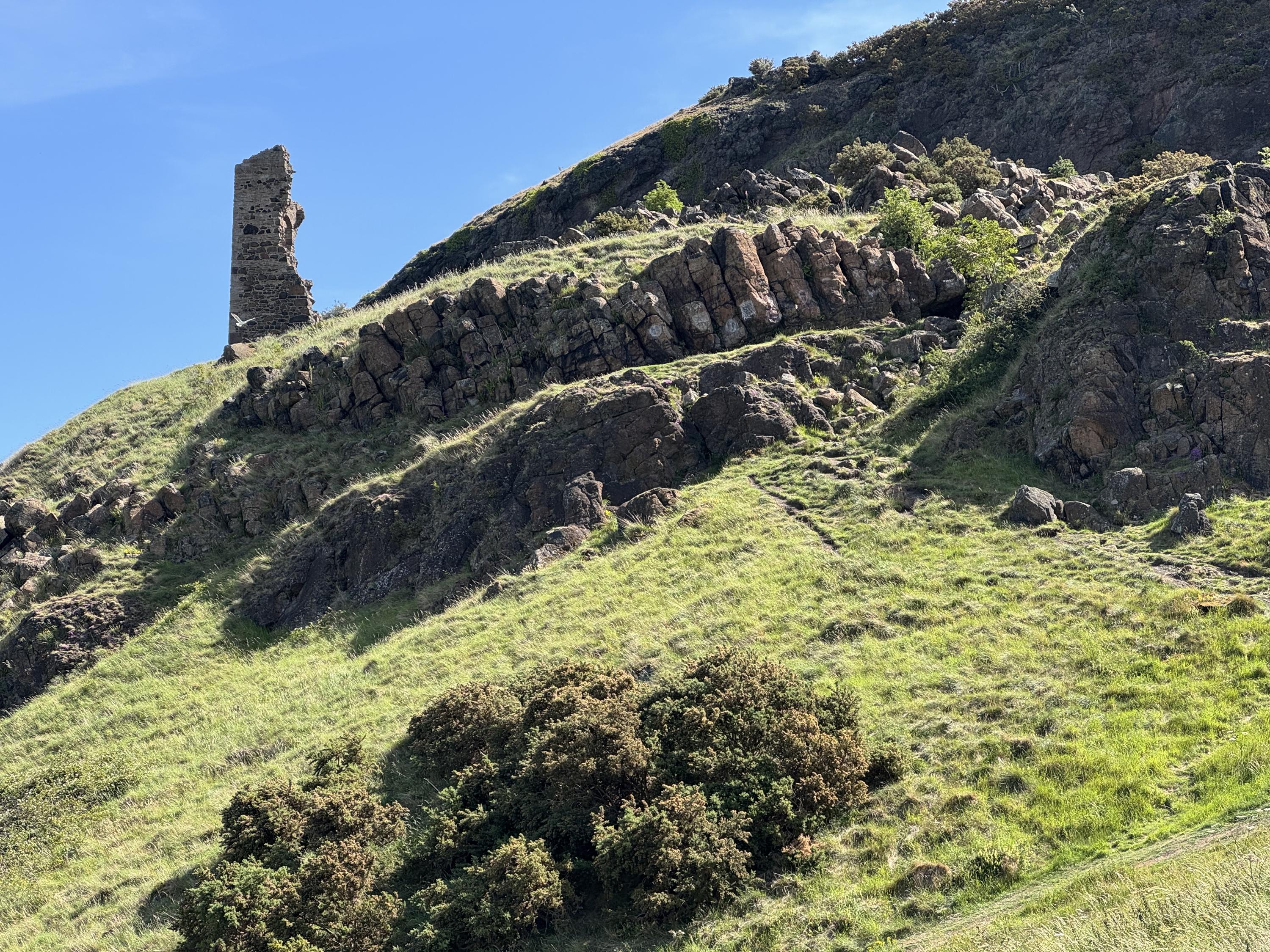
First lava, beneath ruins of St Anthony's chapel, showing good columnar jointing, and tilting of the lava; a greenish layered ash deposit occurs in the eroded gap under the jointed lava, with some plant remains.
Con Gillen
June 29, 2025
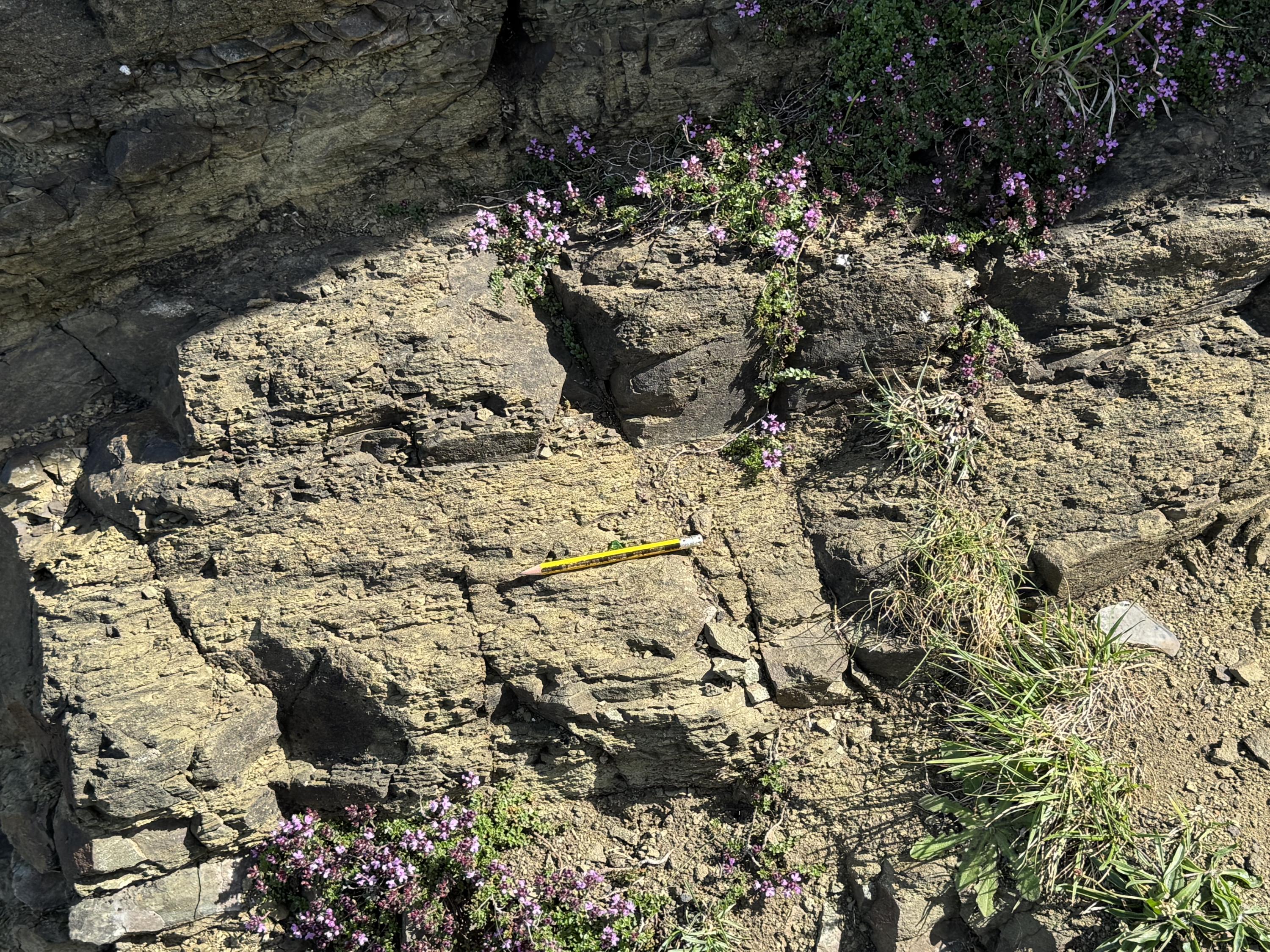
Bedded ash below lava, St Anthony's Chapel.
Con Gillen
June 29, 2025
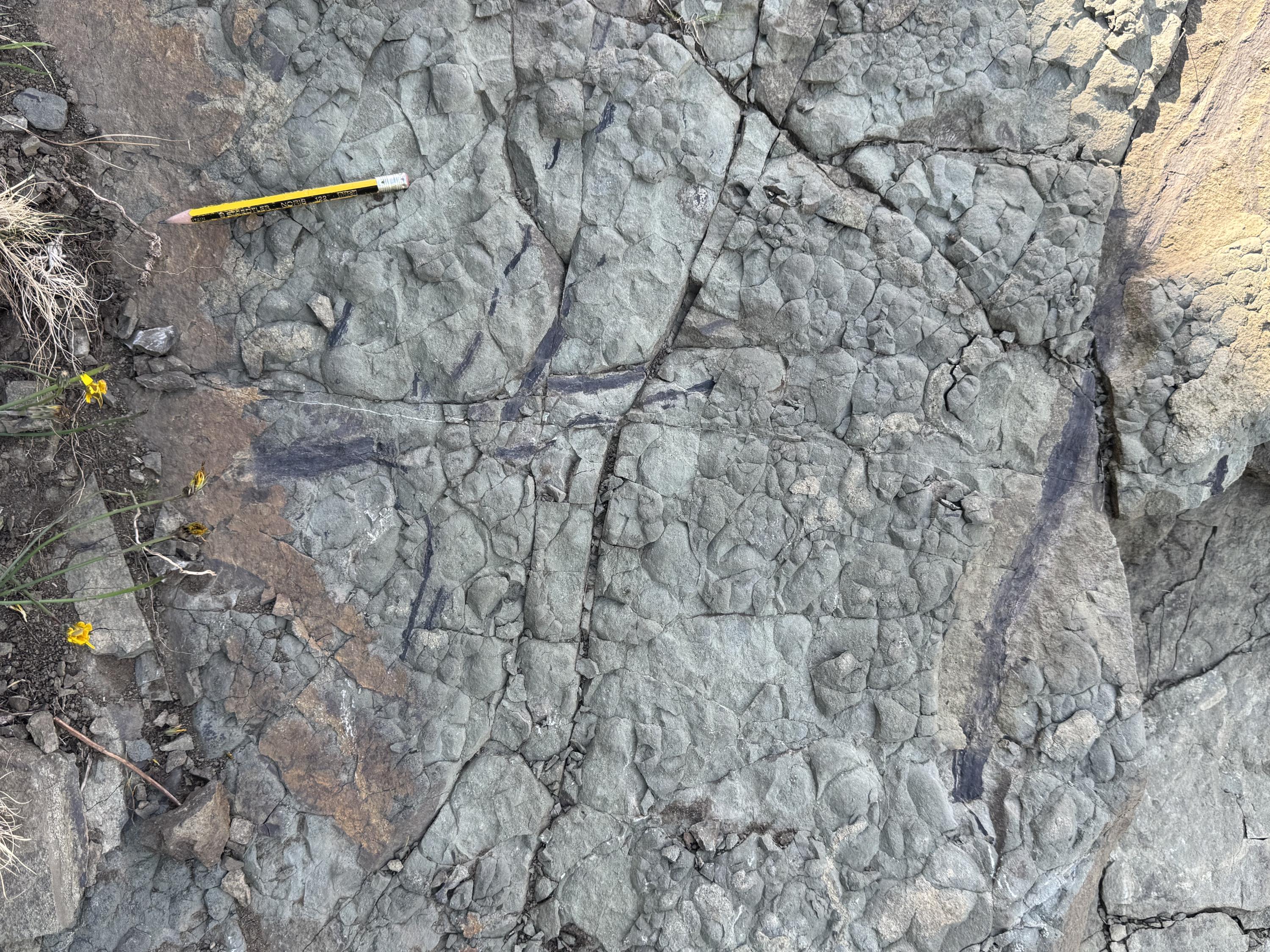
Coalified plant fragments in green ash bed below St Anthony's well lava; probably burnt wood, like charcoal.
Con Gillen
June 29, 2025
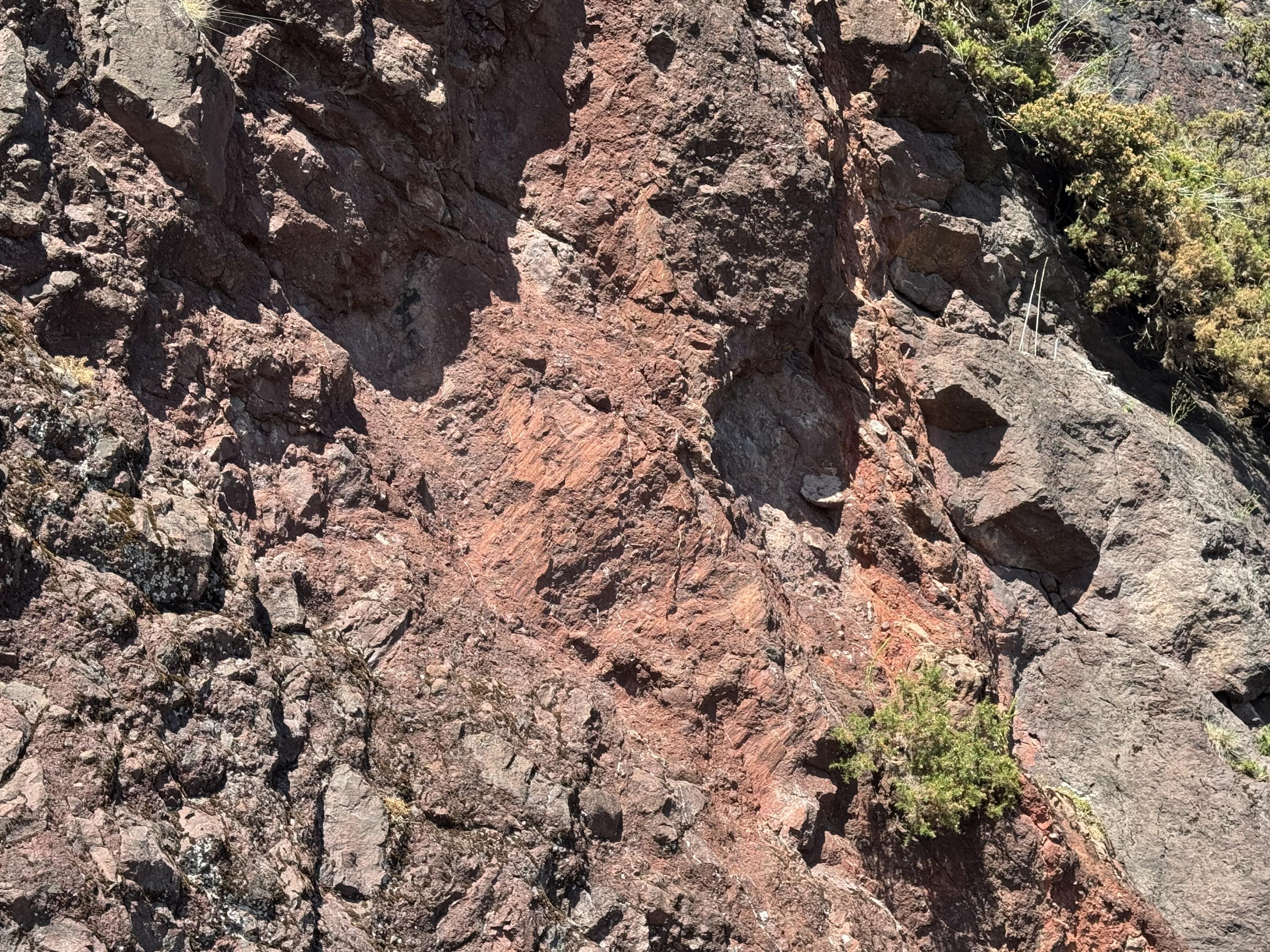
Slickensides within fault zone (coated with red hematite) cutting through agglomerate at edge of Arthur's Seat volcano.
Con Gillen
June 29, 2025
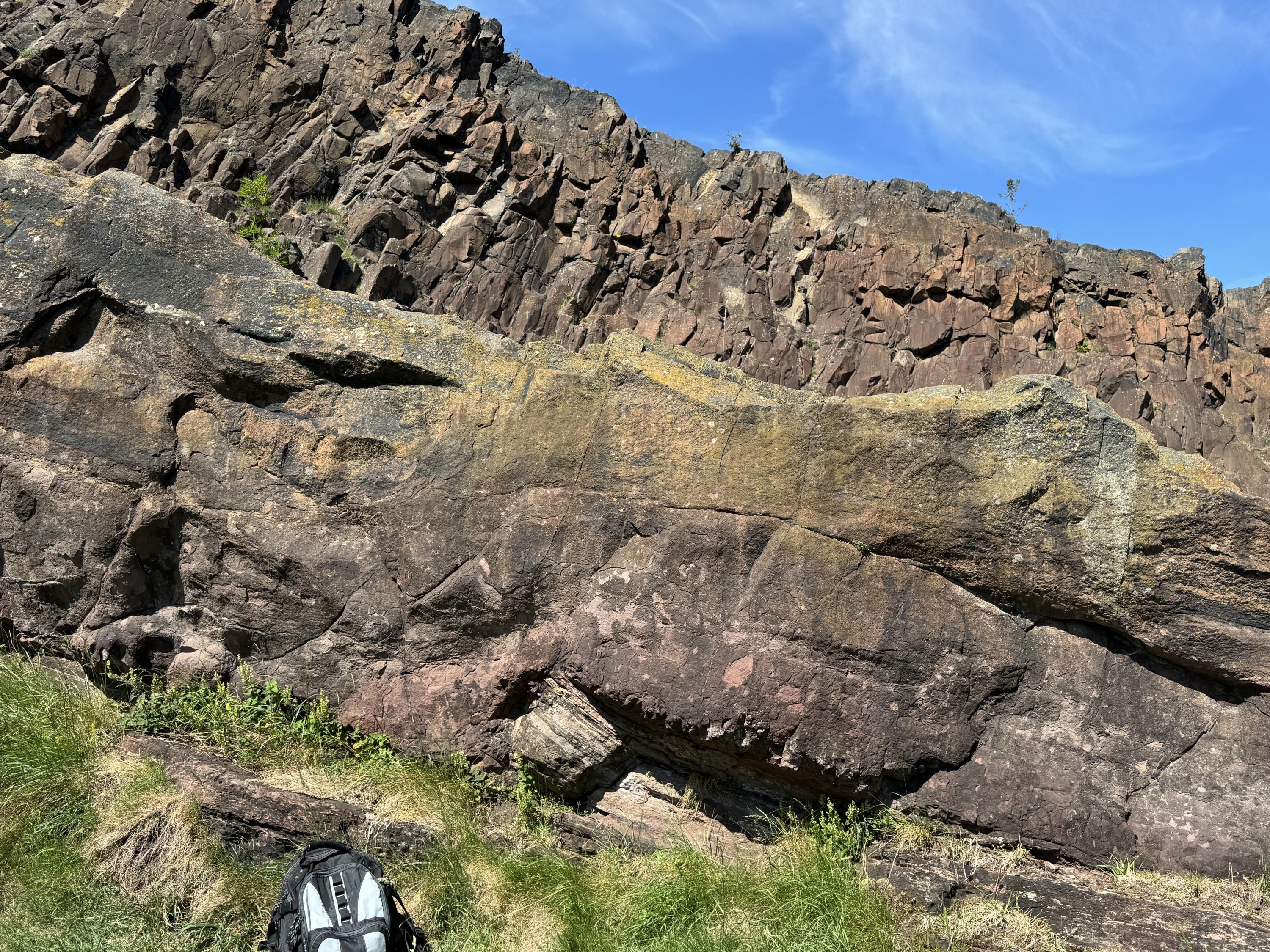
Hutton's Section at the end of the Radical Road. A tongue of the sill has intruded and pushed up the bedding planes of sandstone; columnar jointing is seen in the top of the picture, in the main body of the Salisbury Crags sill. Locality 16 on the map below.
Con Gillen
June 29, 2025
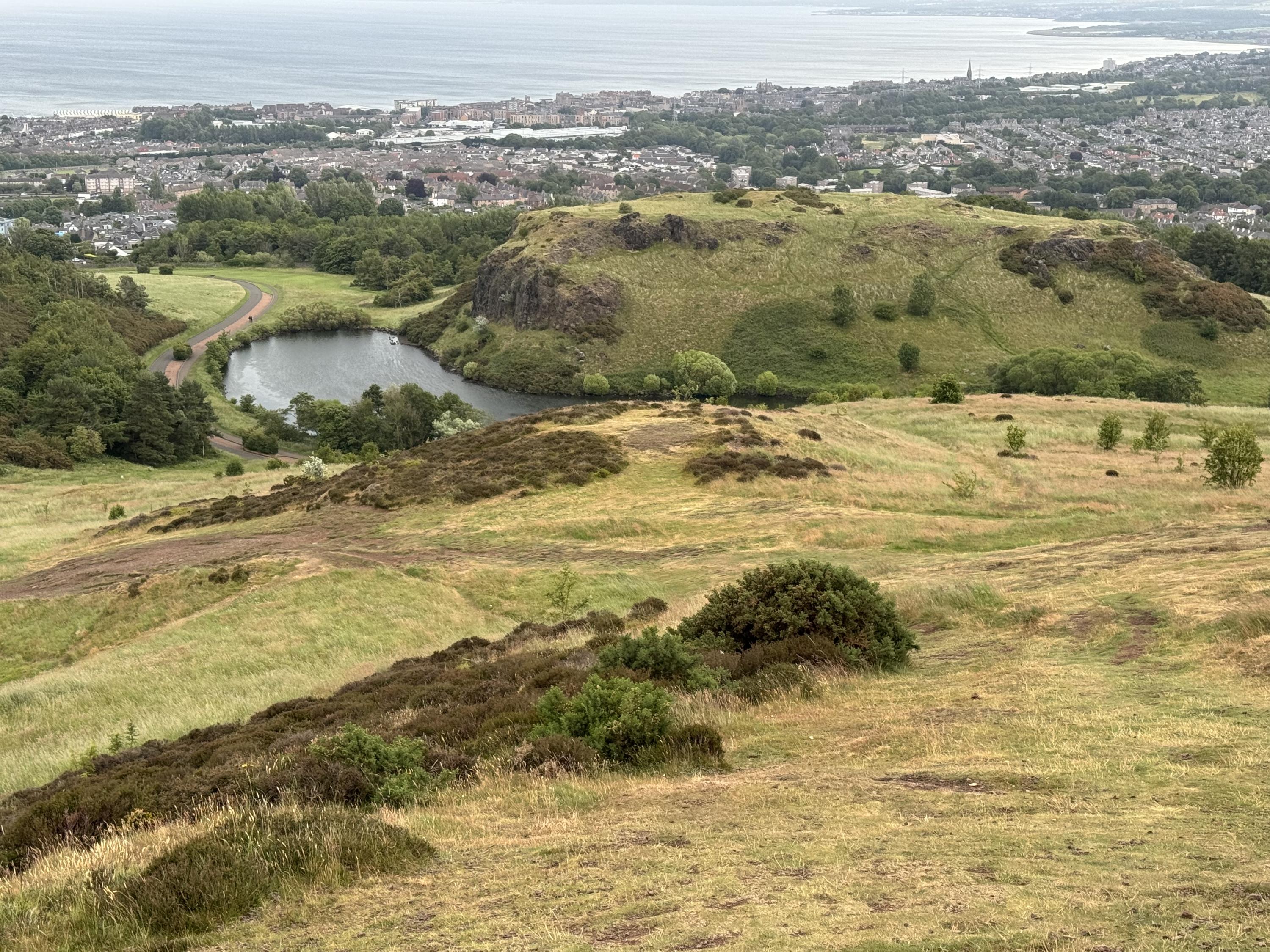
Dunsapie Hill and Dunsapie Loch (locality 11 on the leaflet map). Picture taken from the top of the Dry Dam (a corrie).
Con Gillen
June 27, 2025
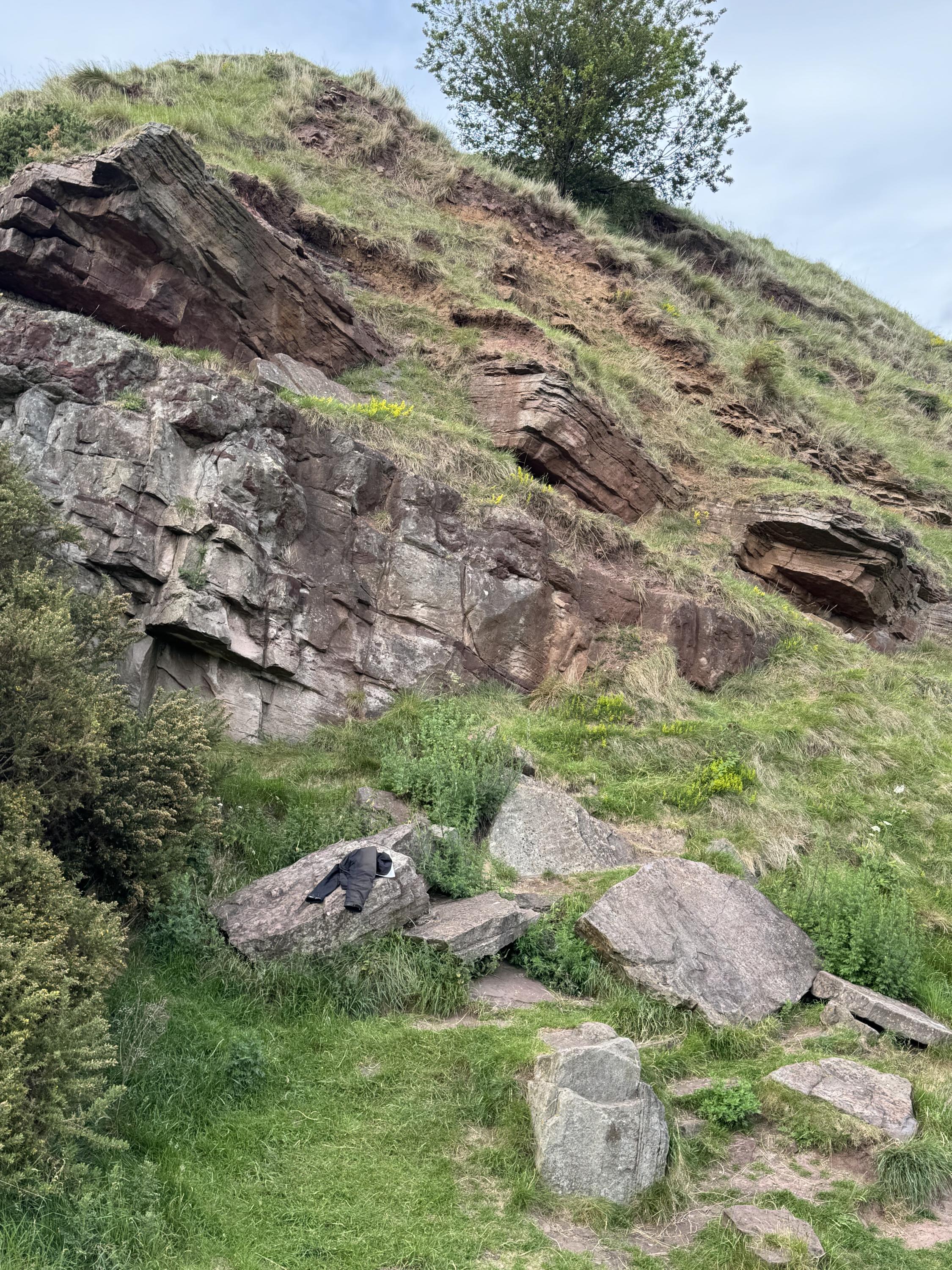
View of sandstone layers in Camstone Quarry (locality 1 on the leaflet map - see below).
Con Gillen
June 27, 2025
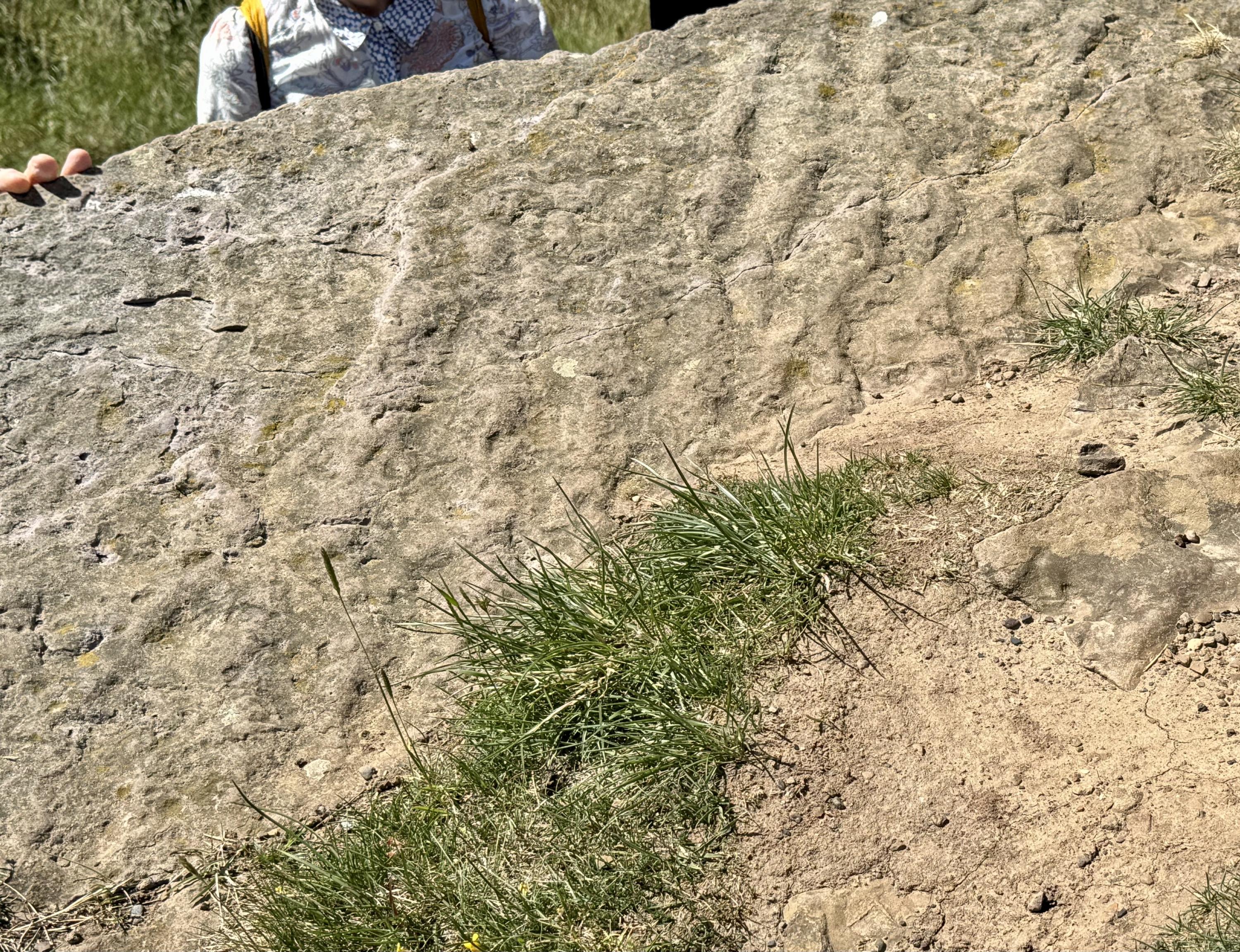
Ripple marks on bedding plane of sandstone, Camstone quarries (upper quarry).
Con Gillen
June 29, 2025
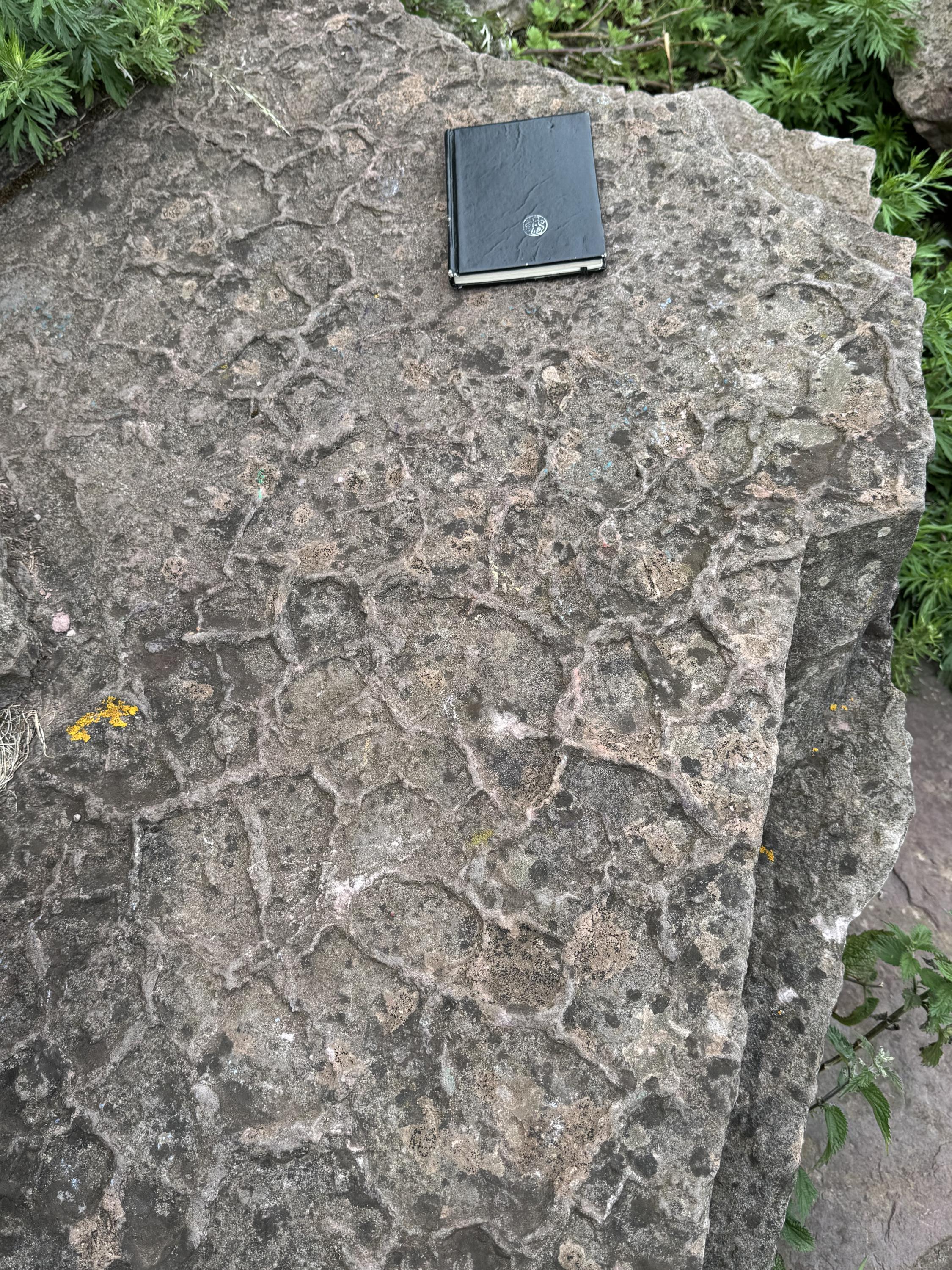
Desiccation cracks on bedding surface of sandstone (fallen block) in Camstone Quarry. Other features in-situ include cross bedding and layers of red mudstone flakes; also ripple marks on another fallen block.
Con Gillen
June 27, 2025
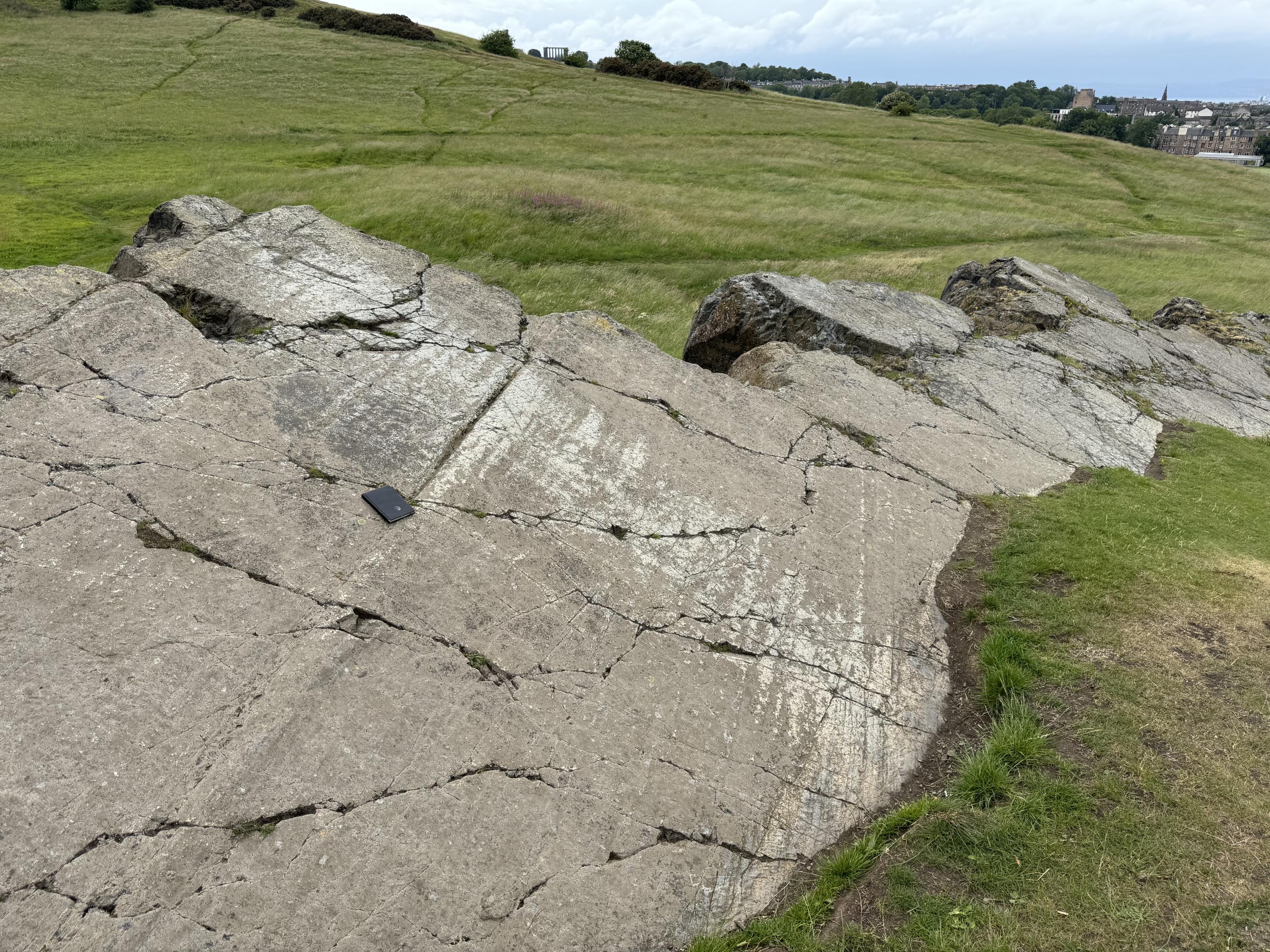
The Dasses - an intrusive sill showing striations (flow banding impressions) formed during intrusion (locality 2 on the leaflet map - see below).
Con Gillen
June 27, 2025
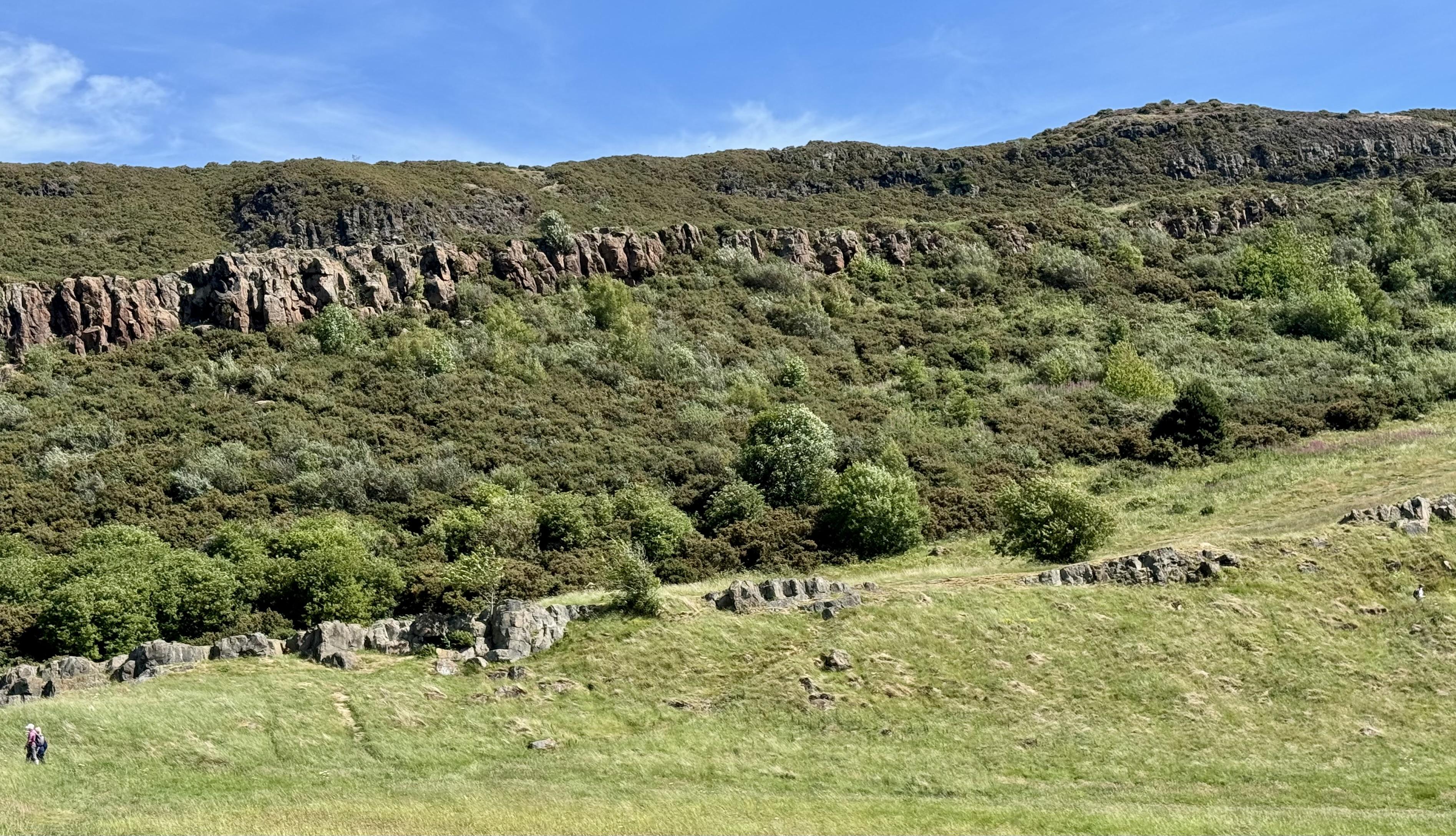
The Dasses sill at the bottom of the picture (pale grey), beneath the jointed lavas on Whinny Hill; taken from start of path to the Camstone quarries.
Con Gillen
June 29, 2025
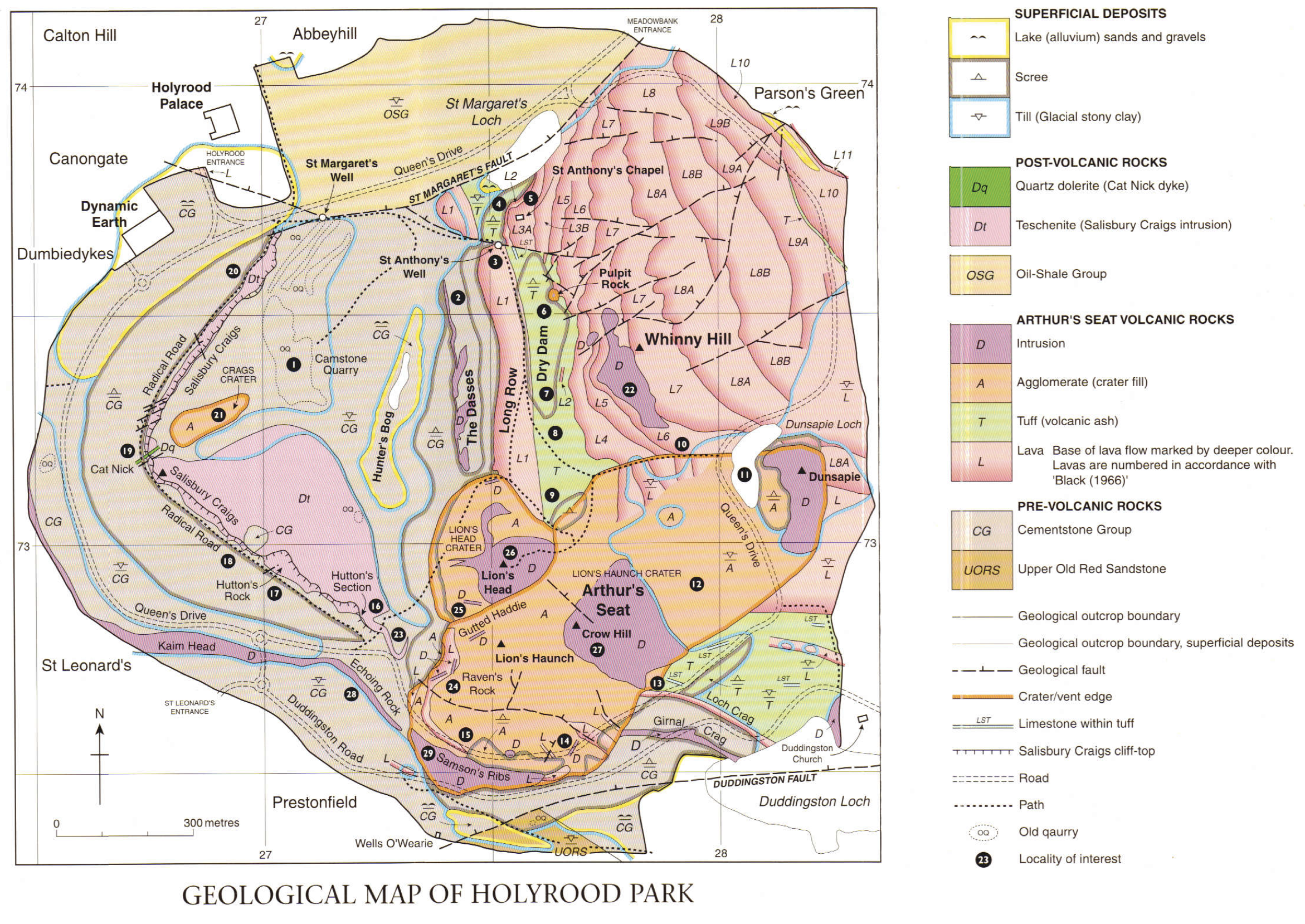
Geological map of Holyrood Park, from EGS leaflet 'Discovering Edinburgh's Volcano'.
Con Gillen
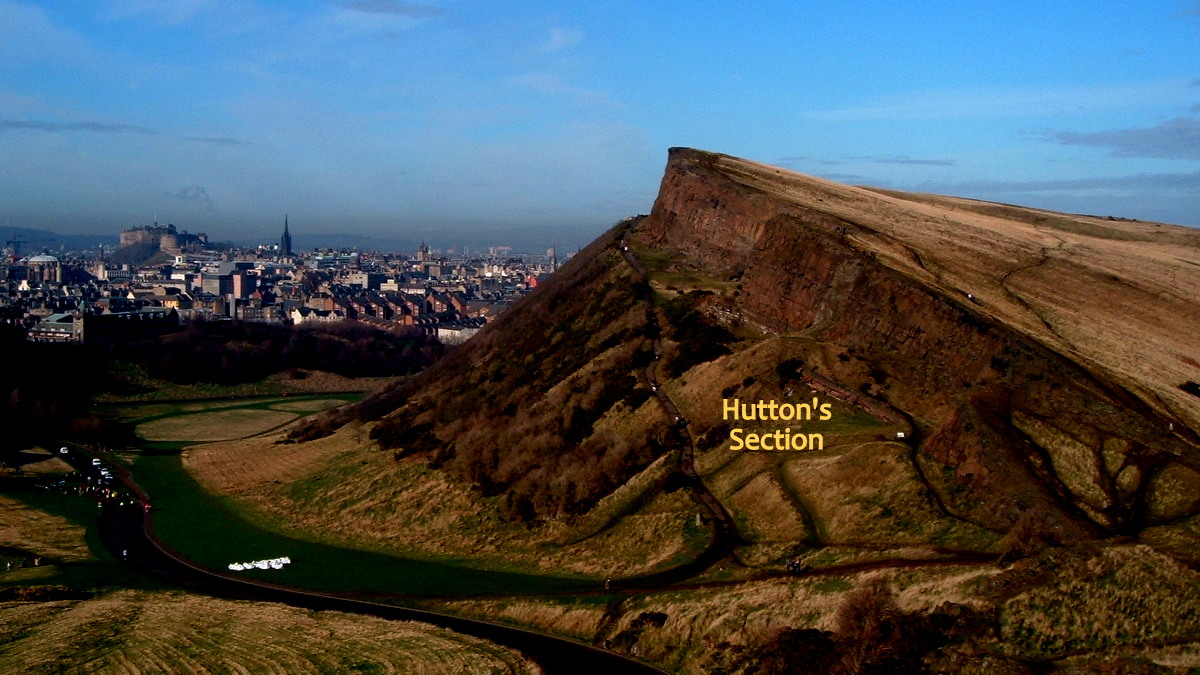
Salisbury Craigs, viewed from the south. The cliff is made of intrusive igneous rock (dolerite), formed when magma intruded into existing sedimentary rock layers. The rocks were later tilted by tectonic movement so that originally flat layers now dip to the east.
Angus Miller
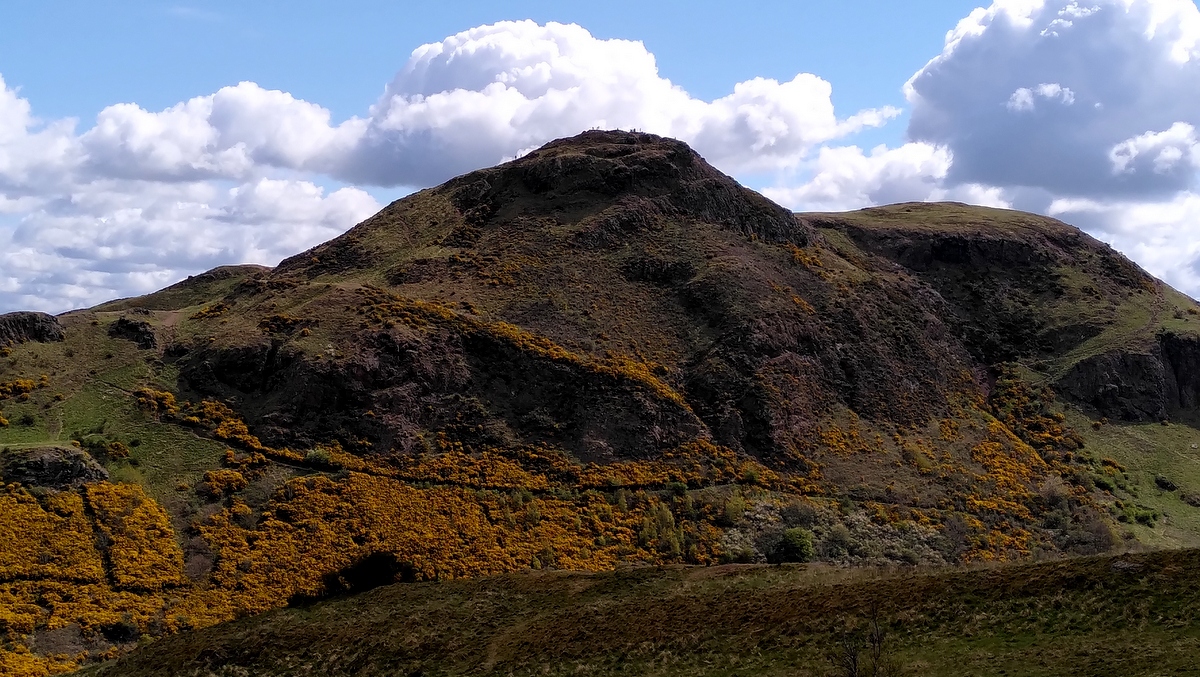
Arthur's Seat, viewed from the northwest. The high ground around the summit area is part of the central vent of the volcano, filled with volcanic breccia and minor intrusions.
Angus Miller
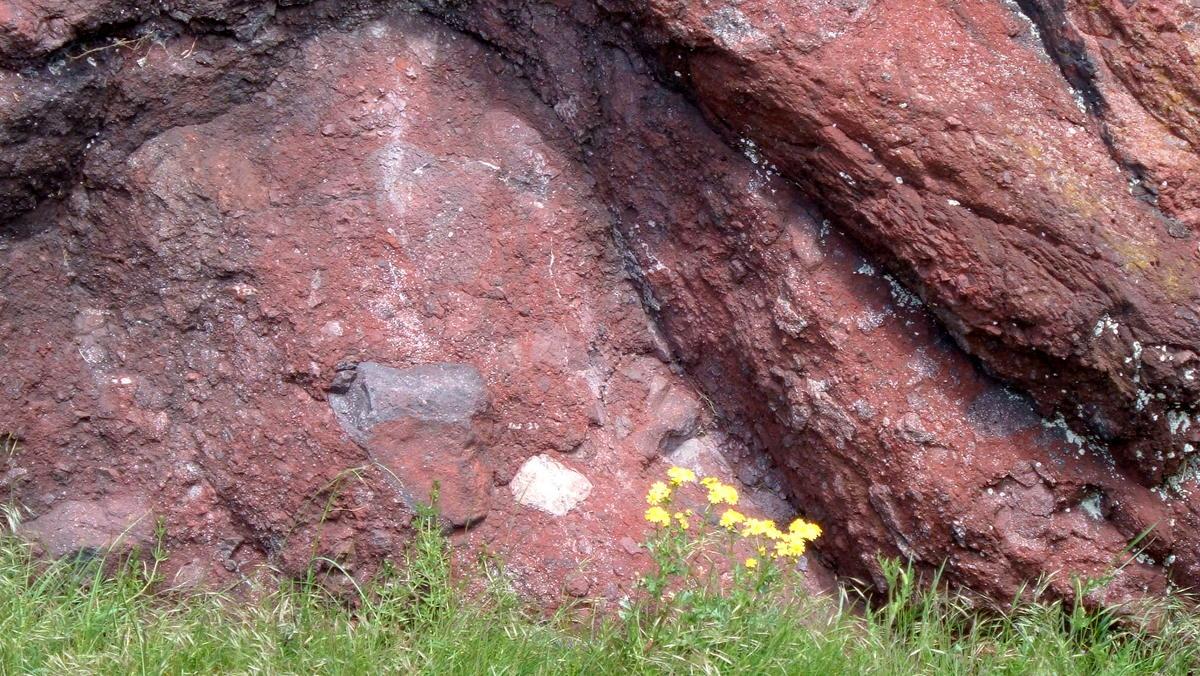
Volcanic breccia with the central vent of Arthur's Seat.
Angus Miller
April 3, 2020